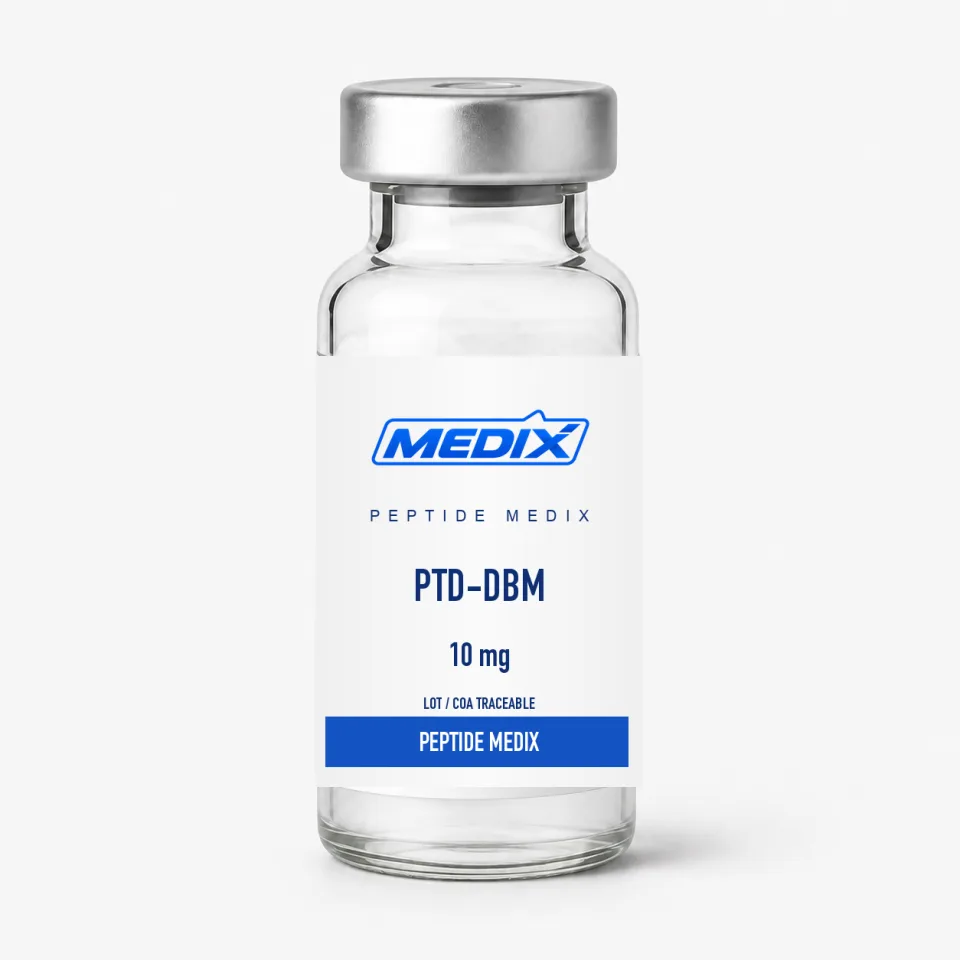
- HPLC purity ≥99% plus MS identity confirmation, COA for every lot
- Certificate of analysis tied to your lot number
- Tracked EU delivery, dispatched the next working day
PTD-DBM
Cell-penetrating peptide that blocks CXXC5–Dishevelled binding, for Wnt research
In stock2 formats available
€97Range €97 – €165
This listing is currently unavailable. Contact us and we will tell you when it is back or suggest an equivalent.
Ask about this listing or request its COA- FormWhite to off-white lyophilized powder in a sealed glass vial
- Research areasHair-follicle neogenesis, dermal papilla signalling, wound repair, Wnt pathway biology
For laboratory research use only. Sold exclusively for in-vitro laboratory research by qualified professionals. Not for human or veterinary use, and not a medicine, food, cosmetic or dietary supplement. Terms and Conditions
Overview
Key facts
PTD-DBM is an engineered fusion peptide with two working parts: a protein transduction domain (PTD) that ferries cargo through the cell membrane, linked to the Dishevelled-binding motif (DBM) of the protein CXXC5.
- Purity
- ≥99% by HPLC with mass-spectrometric identity check; COA per lot
- Form
- White to off-white lyophilized powder in a sealed glass vial
- Storage
- −20 °C, sealed, protected from light and moisture
- Available sizes
- 10 mg · 20 mg
For research use only. Not for human consumption.
PTD-DBM is an engineered fusion peptide with two working parts: a protein transduction domain (PTD) that ferries cargo through the cell membrane, linked to the Dishevelled-binding motif (DBM) of the protein CXXC5. CXXC5 restrains Wnt/β-catenin signalling by binding Dishevelled. The DBM fragment acts as a decoy — by occupying that same binding surface it disrupts the CXXC5–Dishevelled pairing, and in the models studied Wnt signalling is reported to be freed from that restraint.
It was developed by Korean groups working in dermatology and molecular biology on how new hair follicles form and how wounds heal; in mouse experiments it was applied to the skin, sometimes combined with valproic acid as an extra Wnt stimulus. As it interferes with two proteins binding each other instead of acting on a receptor, PTD-DBM is used chiefly as a tool to explore what happens once CXXC5 no longer holds β-catenin back.
Peptide Medix EU supplies PTD-DBM as freeze-dried powder in vials of 10 mg or 20 mg. An independent laboratory confirms ≥99% purity by HPLC, each lot comes with its certificate, and orders ship from our EU warehouse.
What sets this listing apart
PTD-DBM – vial, 10/20 mg. White to off-white lyophilized powder in a sealed glass vial. Other PTD-DBM listings differ in format, fill or combination partners; the specification and COA always refer to the listing you order.
Same compound, other listings
Specifications
Identity
- Peptide class
- Cell-permeable fusion peptide; protein–protein interaction inhibitor
Supply & purity
- Form
- White to off-white lyophilized powder in a sealed glass vial
- Purity
- ≥99% by HPLC with mass-spectrometric identity check; COA per lot
- Available sizes
- 10 mg, 20 mg
- Solubility
- Sterile or bacteriostatic water; verify clarity before use
Handling & storage
- Storage (lyophilized)
- −20 °C, sealed, protected from light and moisture
- Storage (reconstituted)
- 2–8 °C for short study windows; aliquot to avoid freeze–thaw
Additional detail
- Construct
- Protein transduction domain fused to the Dishevelled-binding motif of CXXC5
- Molecular target
- CXXC5–Dishevelled interaction within Wnt/β-catenin signalling
- Research areas
- Hair-follicle neogenesis, dermal papilla signalling, wound repair, Wnt pathway biology
- Commonly co-studied with
- Valproic acid and other Wnt-activating inputs
- Vial contents
- Peptide only — no diluent, carrier or preservative
Questions about PTD-DBM
What is PTD-DBM?
A synthetic fusion of a protein transduction domain with CXXC5's Dishevelled-binding motif. In research it acts as a decoy competing with CXXC5 for Dishevelled — an interaction upstream of β-catenin in the Wnt pathway.
Has the lot been tested independently, and can I view the COA?
Yes. Each production lot is checked for identity and purity by an independent lab using HPLC plus mass spectrometry, and the lot certificate — stating lot number, assay result and test date — can be requested before you buy.
What's in the vial, and which sizes exist?
Just the freeze-dried peptide — nothing added, whether diluent, carrier or preservative — in 10 mg or 20 mg. That leaves your lab free to choose how to dissolve it, how concentrated to make it and what else, if anything, to add.
How do I reconstitute and store it?
Most researchers dissolve it in sterile or bacteriostatic water, pouring slowly down the side of the vial and swirling until the liquid is clear. Store unopened powder frozen at −20 °C, shielded from light and humidity; keep dissolved peptide in the fridge (2–8 °C) as single-use portions and don't let it freeze and thaw repeatedly.
Is there a published CAS number or full sequence?
PTD-DBM was engineered for research and is not a catalogued commercial chemical, and descriptions in the literature differ in how they define its transduction segment and binding motif. We therefore list only what the certificate for your lot confirms and leave out CAS number, formula and full sequence rather than publish uncertain values.