- HPLC-assayed purity of ≥99%
- Certificate of analysis tied to your lot number
- Tracked EU delivery, dispatched the next working day
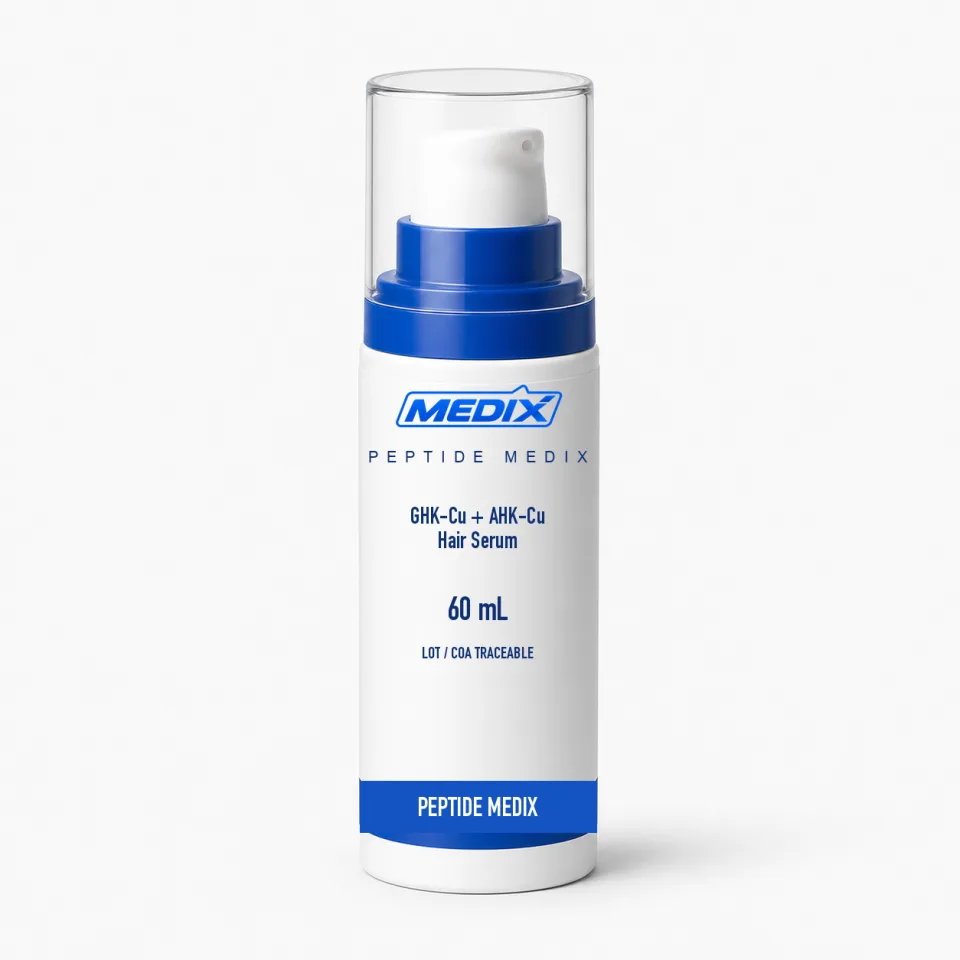
GHK-Cu + AHK-Cu Hair Serum
Leave-on scalp serum with two copper peptides, 60 mL dropper bottle
In stock1 format available
€97
This listing is currently unavailable. Contact us and we will tell you when it is back or suggest an equivalent.
Ask about this listing or request its COA- FormBlue-tinted aqueous leave-on serum in a dropper bottle
- Research areasDermal papilla cell signalling, follicle-cycle models, angiogenic marker expression, combination formulation studies
For laboratory research use only. Sold exclusively for in-vitro laboratory research by qualified professionals. Not for human or veterinary use, and not a medicine, food, cosmetic or dietary supplement. Terms and Conditions
Overview
Key facts
This leave-on scalp serum combines the two copper-chelating tripeptides that dominate follicle research — GHK-Cu and AHK-Cu — in one preparation, filled into a 60 mL dropper bottle.
- Form
- Blue-tinted aqueous leave-on serum in a dropper bottle
- Storage
- 2–8 °C preferred, protected from light; keep the dropper closure tight
- Available size
- 60 mL
For research use only. Not for human consumption.
This leave-on scalp serum combines the two copper-chelating tripeptides that dominate follicle research — GHK-Cu and AHK-Cu — in one preparation, filled into a 60 mL dropper bottle. GHK-Cu is glycyl-L-histidyl-L-lysine complexed with copper(II) (CAS 89030-95-5, C14H24N6O4·Cu, 403.93 g/mol), listed in INCI terms as copper tripeptide-1. AHK-Cu swaps the glycine for alanine and is listed as copper tripeptide-3.
Both peptides hold copper because their His-Lys motif creates a square-planar binding site with high affinity for Cu(II) — which is also why they look blue, whether as powder or in solution. That colour gives the easiest visual check of an intact complex: once a serum has turned colourless, its copper is no longer coordinated, regardless of the peptide content on the label.
What sets this listing apart
GHK-Cu + AHK-Cu Hair Serum – cream/serum, 60 mL. Blue-tinted aqueous leave-on serum in a dropper bottle. Other GHK-Cu listings differ in format, fill or combination partners; the specification and COA always refer to the listing you order.
Same compound, other listings
Specifications
Supply & purity
- Form
- Blue-tinted aqueous leave-on serum in a dropper bottle
Additional detail
- Available size
- 60 mL
- Active 1
- GHK-Cu — copper(II) complex of glycyl-L-histidyl-L-lysine (INCI copper tripeptide-1)
- Active 1 identifiers
- CAS 89030-95-5 · C14H24N6O4·Cu · 403.93 g/mol
- Active 2
- AHK-Cu — copper(II) complex of alanyl-L-histidyl-L-lysine (INCI copper tripeptide-3)
- Active 2 identifiers
- CAS 1245800-58-7 · C15H26N6O4·Cu · ≈417.96 g/mol as the copper complex
- Peptide purity inputs
- ≥99% by HPLC for both actives; lot-matched COAs available
- Concentrations
- Printed on the lot label; comparable research serums typically run each copper tripeptide near 1%
- Vehicle
- Lightweight aqueous leave-on base, low residue, no added fragrance or colourant
- Colour
- Blue to blue-violet — colour intensity tracks intact copper coordination
- Research areas
- Dermal papilla cell signalling, follicle-cycle models, angiogenic marker expression, combination formulation studies
- Storage
- 2–8 °C preferred, protected from light; keep the dropper closure tight
- Compatibility note
- Reducing agents and strong chelators dissociate copper from both tripeptides
Questions about GHK-Cu + AHK-Cu Hair Serum
What does the serum contain?
A leave-on aqueous base with two copper-binding tripeptides: GHK-Cu (glycyl-L-histidyl-L-lysine bound to copper(II)) and AHK-Cu, its alanine counterpart. Both inputs are ≥99% pure by HPLC, and the lot label states the concentration of each.
What separates GHK-Cu from AHK-Cu?
Just one amino acid: GHK starts with glycine, AHK with alanine. They share the His-Lys motif that builds the square-planar copper site. Being so alike, they are often studied together — which makes matched single-active controls essential in combination experiments.
Where does the blue colour come from?
From copper(II) held by the tripeptides; the stronger the blue, the more complex remains intact. A preparation that fades towards colourless or drifts to green-brown has had its coordination disrupted and no longer contains the same active.
Which purity documents can I get?
Both peptide inputs are tested by reversed-phase HPLC to ≥99%, and their lot certificates are available on request. The label of each finished serum lot records the concentration of both actives in that batch.
What should it not be combined with?
Reducing agents like ascorbic acid, thiols, strong chelators such as EDTA and strongly acidic media all interfere with copper binding. For cell experiments, bear in mind that copper in the culture medium matters too, because free copper ions act very differently from the bound complex.
How is the serum stored?
Ideally in the fridge at 2–8 °C, upright, tightly capped and away from direct light. Use the dropper to transfer serum into a clean vessel and never pour leftovers back — once opened, water-based leave-on products are prone to contamination.
Related