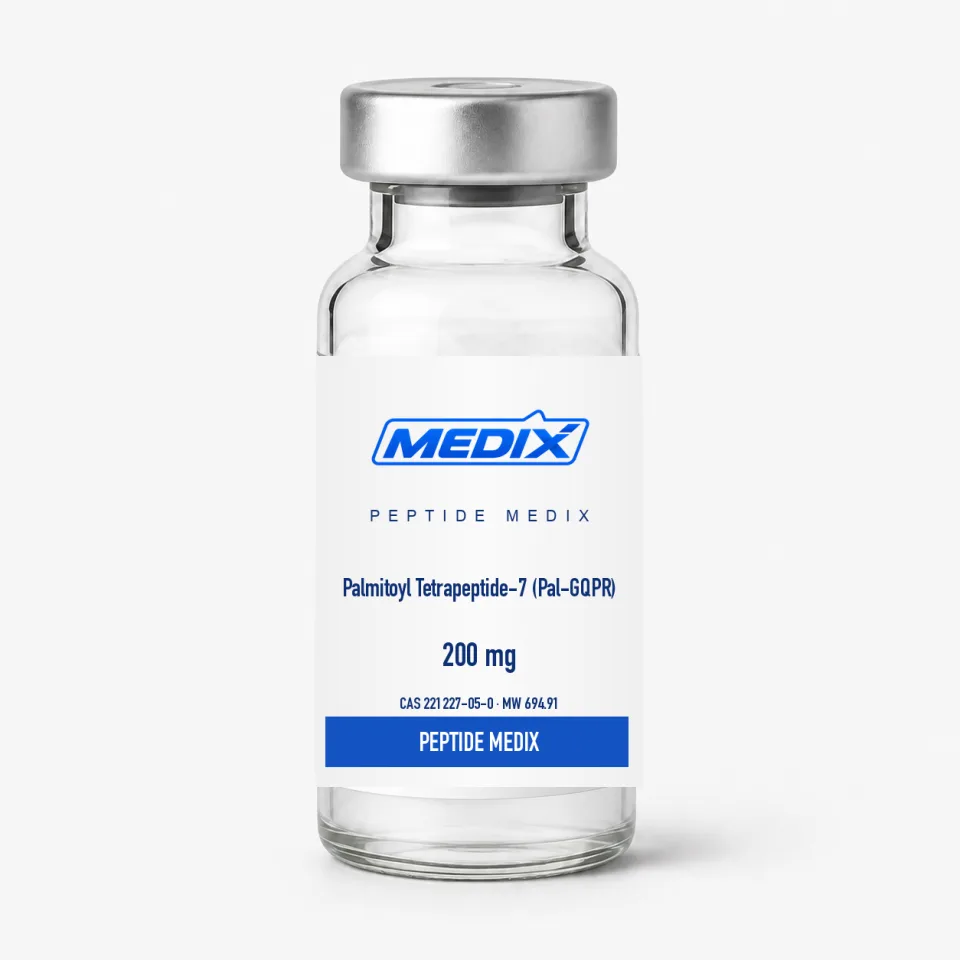
- HPLC purity ≥99%, with a COA for each lot on request
- Certificate of analysis tied to your lot number
- Tracked EU delivery, dispatched the next working day
Palmitoyl Tetrapeptide-7 (Pal-GQPR)
Lipidated GQPR peptide for matrix, cytokine and skin-permeation models
In stock1 format availableCAS 221227-05-0
€199
This listing is currently unavailable. Contact us and we will tell you when it is back or suggest an equivalent.
Ask about this listing or request its COA- FormLyophilized amphiphilic peptide powder, sealed glass vial
- Mol. weight694.91 g/mol
- Research areasFibroblast extracellular-matrix output, cytokine markers, UV-stress models, peptide permeation and formulation stability
For laboratory research use only. Sold exclusively for in-vitro laboratory research by qualified professionals. Not for human or veterinary use, and not a medicine, food, cosmetic or dietary supplement. Terms and Conditions
Overview
Key facts
Palmitoyl Tetrapeptide-7 (Pal-GQPR) is Gly-Gln-Pro-Arg acylated at the N-terminus with palmitic acid.
- CAS number
- 221227-05-0
- Molecular formula
- C34H62N8O7
- Molecular weight
- 694.91 g/mol
- Amino acid sequence
- Palmitoyl-Gly-Gln-Pro-Arg-OH (Pal-GQPR)
- Purity
- ≥99% by HPLC; lot-matched COA available
- Form
- Lyophilized amphiphilic peptide powder, sealed glass vial
- Storage
- −20 °C lyophilized; protect from light and moisture
- Available size
- 200 mg
For research use only. Not for human consumption.
Palmitoyl Tetrapeptide-7 (Pal-GQPR) is Gly-Gln-Pro-Arg acylated at the N-terminus with palmitic acid. The GQPR sequence is linked to a fragment of immunoglobulin G, and the 16-carbon chain boosts lipophilicity, changing how the peptide distributes into membranes, emulsions and other lipid-rich systems. The free tetrapeptide is also known as rigin and shares its C-terminal Pro-Arg with tuftsin (Thr-Lys-Pro-Arg), another short immunoglobulin-derived sequence — worth noting, because it means this peptide is not a true matrikine, since matrikines derive from extracellular-matrix proteins, not antibodies.
It is best known as one of the two peptides in Matrixyl 3000-type formulas, paired with Palmitoyl Tripeptide-1. A separate vial allows labs to study Pal-GQPR by itself, quantify it independently and run single-agent controls before interpreting a two-peptide blend. Published studies lean towards formulation, fibroblast, matrix and cytokine-marker models, and independent evidence is thinner than branded mixture claims might imply. Acylation adds about 238 Da of purely hydrophobic mass, so comparing equal weights with the unmodified sequence means comparing unequal numbers of molecules — designs matched by molarity are the meaningful ones.
The 200 mg vial contains lyophilised Pal-GQPR (CAS 221227-05-0, C34H62N8O7, 694.91 g/mol), HPLC-tested with a certificate of analysis for the lot. It is supplied only as laboratory research material, not as a finished cosmetic or medicinal product.
Specifications
Identity
- CAS number
- 221227-05-0
- Molecular formula
- C34H62N8O7
- Molecular weight
- 694.91 g/mol
- Peptide class
- Lipidated tetrapeptide / matrikine-associated cosmetic peptide
Supply & purity
- Form
- Lyophilized amphiphilic peptide powder, sealed glass vial
- Purity
- ≥99% by HPLC; lot-matched COA available
- Solubility
- Low water solubility; use a validated co-solvent or surfactant vehicle
Additional detail
- Available size
- 200 mg
- Sequence
- Palmitoyl-Gly-Gln-Pro-Arg-OH (Pal-GQPR)
- Also known as
- Pal-GQPR, Palmitoyl-GQPR, N-Palmitoyl Rigin, Rigin
- Research areas
- Fibroblast extracellular-matrix output, cytokine markers, UV-stress models, peptide permeation and formulation stability
- Storage
- −20 °C lyophilized; protect from light and moisture
Questions about Palmitoyl Tetrapeptide-7 (Pal-GQPR)
Is Palmitoyl Tetrapeptide-7 simply Matrixyl 3000?
No. It is a single defined peptide, Pal-GQPR, whereas Matrixyl 3000-type systems blend it with Palmitoyl Tripeptide-1 in a formulated mixture. This stand-alone vial makes single-agent controls and separate quantification possible.
What is its sequence?
Gly-Gln-Pro-Arg with a C16 palmitoyl group on the N-terminus — written Pal-GQPR. It is registered as CAS 221227-05-0, molecular weight 694.91 g/mol.
Why does it dissolve so poorly in water?
The 16-carbon palmitoyl chain presents a large hydrophobic surface. That improves partitioning into lipid phases but also promotes aggregation and sticking to surfaces, so vehicle and labware must be chosen carefully and recorded.
How does it compare with Palmitoyl Tripeptide-1?
Palmitoyl Tripeptide-1 is built on Gly-His-Lys, Palmitoyl Tetrapeptide-7 on Gly-Gln-Pro-Arg. They carry the same kind of fatty tail but are different sequences addressing different research questions.
Related