- HPLC-assayed purity of ≥99%
- Certificate of analysis tied to your lot number
- Tracked EU delivery, dispatched the next working day
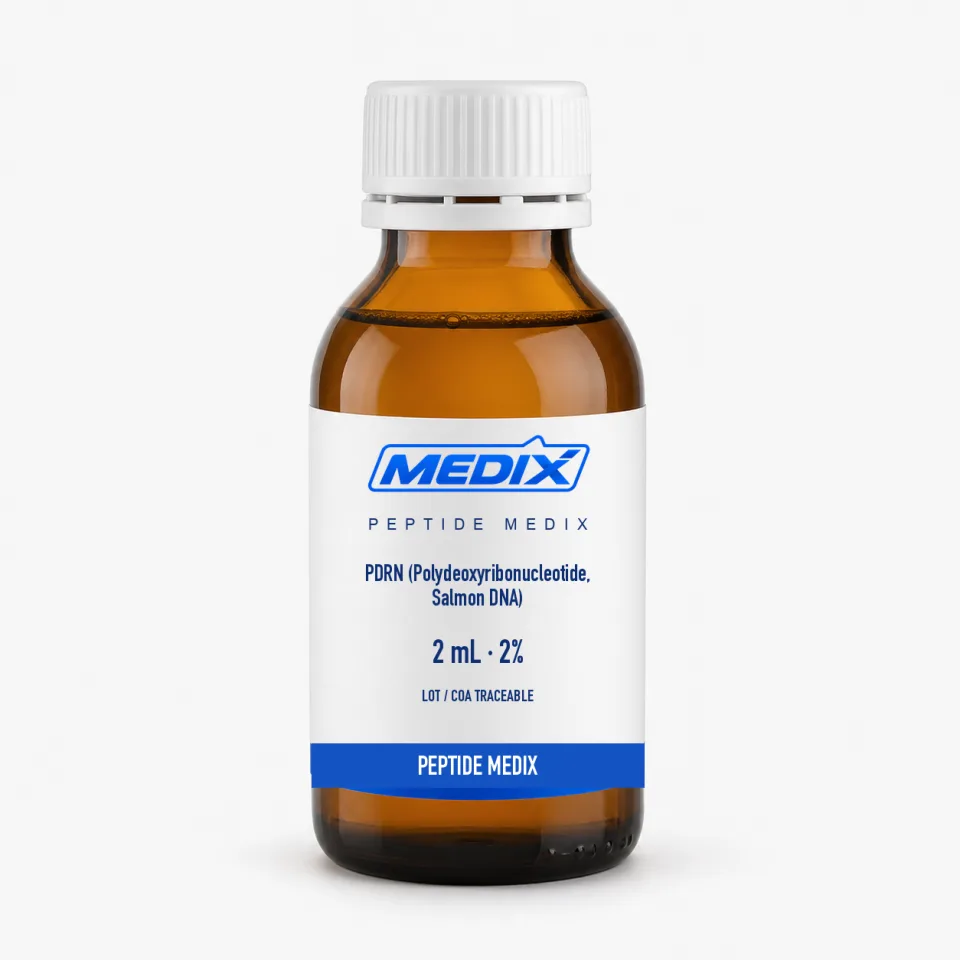
PDRN (Polydeoxyribonucleotide, Salmon DNA)
Salmon-derived polydeoxyribonucleotide, 2% solution — 2 mL or 5 mL vial
In stock2 formats available
€68Range €68 – €131
This listing is currently unavailable. Contact us and we will tell you when it is back or suggest an equivalent.
Ask about this listing or request its COA- FormClear aqueous solution in a sealed glass vial; supplied ready to sample
- Research areasAngiogenic signalling, fibroblast proliferation, extracellular matrix and collagen synthesis, inflammatory markers, wound models
For laboratory research use only. Sold exclusively for in-vitro laboratory research by qualified professionals. Not for human or veterinary use, and not a medicine, food, cosmetic or dietary supplement. Terms and Conditions
Overview
Key facts
PDRN (polydeoxyribonucleotide) consists of many short DNA pieces, typically said to range from about 50 up to 1,500 kilodaltons.
- Form
- Clear aqueous solution in a sealed glass vial; supplied ready to sample
- Storage
- 2–8 °C, upright, protected from light; do not freeze
- Available sizes
- 2 mL · 2-pack · 5 mL · 2-pack
For research use only. Not for human consumption.
PDRN (polydeoxyribonucleotide) consists of many short DNA pieces, typically said to range from about 50 up to 1,500 kilodaltons. They are made by extracting DNA from salmonid gonads and cutting it enzymatically under controlled conditions. PDRN is therefore neither a peptide nor one defined molecule, but a polymer mixture with a known profile — the reason its lot paperwork reports how fragment sizes are distributed and how pure the material is, rather than giving a formula and molecular weight.
Salmon is the preferred source because its DNA is similar enough in base composition for human salvage enzymes to process it, there is plenty of raw material, and purification removes the protein and peptide impurities that would otherwise interfere with assays. You receive a 2% water-based solution, ready to sample, in sealed vials of 2 mL or 5 mL — no reconstitution step, and a concentration that is set and documented.
Specifications
Supply & purity
- Form
- Clear aqueous solution in a sealed glass vial; supplied ready to sample
- Available sizes
- 2 mL at 2%; 5 mL at 2%
Additional detail
- Concentration
- 2% w/v (20 mg/mL polydeoxyribonucleotide)
- Active
- Polydeoxyribonucleotide (PDRN), a mixture of low-molecular-weight DNA fragments
- Source material
- DNA purified from salmonid (Oncorhynchus) gonadal tissue
- Fragment size
- Commonly cited at approximately 50–1,500 kDa; a distribution rather than a single mass
- Chemical class
- Nucleic acid polymer — deoxyribonucleotide chains, not a peptide
- Proposed mechanisms
- Adenosine A2A receptor agonism; nucleotide supply to the purine salvage pathway
- Research areas
- Angiogenic signalling, fibroblast proliferation, extracellular matrix and collagen synthesis, inflammatory markers, wound models
- Related preparation
- PN (polynucleotide) preparations use longer chains from the same source chemistry
- Appearance
- Clear, colourless to very faintly opalescent liquid, free of visible particulates
- Storage
- 2–8 °C, upright, protected from light; do not freeze
Questions about PDRN (Polydeoxyribonucleotide, Salmon DNA)
What does PDRN stand for?
The name stands for polydeoxyribonucleotide: DNA from salmonids, purified and broken into short pieces within a set size window — commonly quoted as roughly 50 to 1,500 kDa. It is a nucleic-acid product, not a peptide, so it is described by how its fragment sizes are spread and how pure it is, not by a chemical formula.
Why use salmon as the DNA source?
Salmonid gonads provide DNA in quantity and are thoroughly studied, and the base make-up of that DNA resembles human DNA closely enough for our own salvage enzymes to work on it in lab systems. The purification process is built to strip away proteins and peptides that could otherwise skew findings.
What distinguishes PDRN from PN (polynucleotide) products?
They start from the same raw material. PN keeps its chains long and attracts interest for physical behaviour — gel formation and biostimulation — whereas PDRN is cut into shorter pieces and draws interest for receptor activity and the salvage pathway. The dividing line in practice is fragment length.
Does it need to be reconstituted?
No. What arrives is a 2% solution in water — 20 mg per mL — sealed in its vial and ready to sample, so you know the concentration from the outset. You only need to dilute it into whatever buffer or vehicle your protocol specifies; there is no powder to dissolve.
Can I get a certificate of analysis?
Yes, every lot has one, stating identity, concentration and purity for that batch. PDRN is a mixture, not a single compound, so log the lot number next to your results; that way each finding can be traced to the size profile of the material used.
How should PDRN be stored?
Store it refrigerated at 2–8 °C, standing upright, away from light. Do not freeze it — repeated freezing and thawing can alter the spread of fragment sizes that characterises the product. Leave vials sealed until needed and withdraw using aseptic technique.