- HPLC-assayed purity of ≥99%
- Certificate of analysis tied to your lot number
- Tracked EU delivery, dispatched the next working day
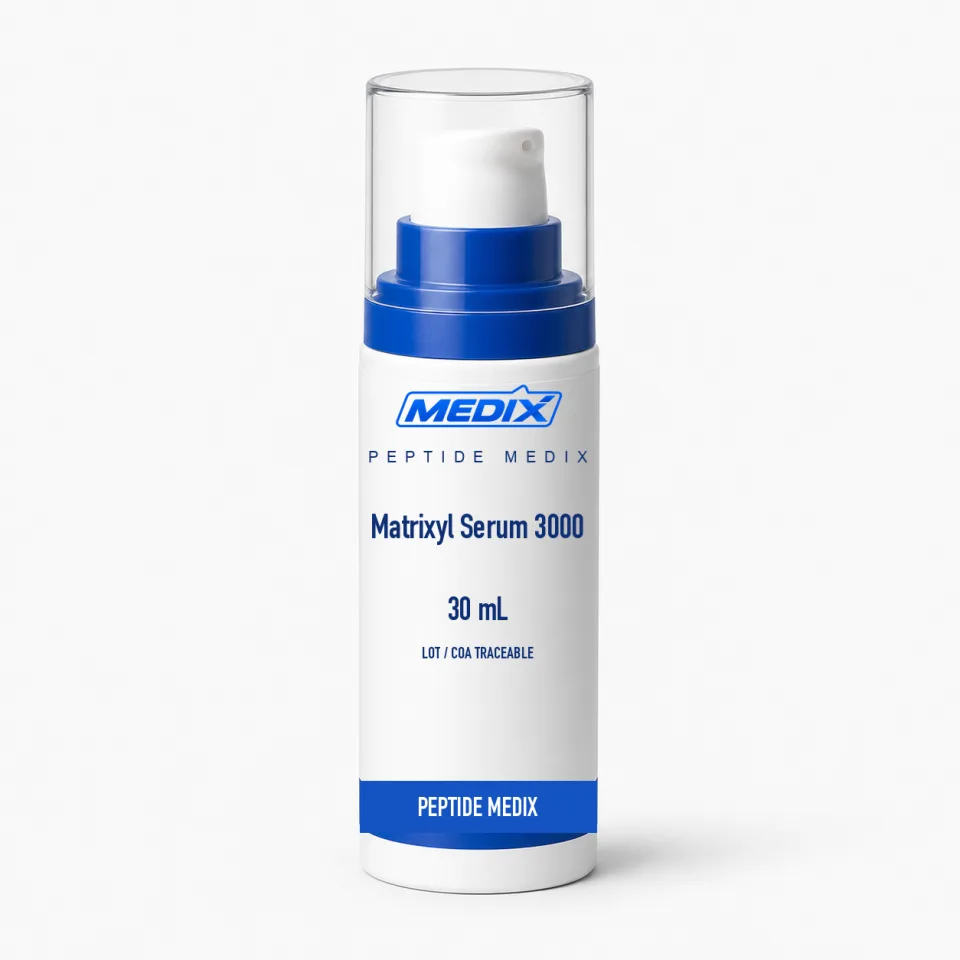
Matrixyl Serum 3000
Water-based serum pairing palmitoyl tripeptide-1 with palmitoyl tetrapeptide-7 — 30 mL
In stock1 format available
€55
This listing is currently unavailable. Contact us and we will tell you when it is back or suggest an equivalent.
Ask about this listing or request its COA- FormClear low-viscosity aqueous serum in a 30 mL bottle
- Research areasProcollagen and glycosaminoglycan synthesis, ECM remodelling, cytokine markers in dermal models, skin permeation
For laboratory research use only. Sold exclusively for in-vitro laboratory research by qualified professionals. Not for human or veterinary use, and not a medicine, food, cosmetic or dietary supplement. Terms and Conditions
Overview
Key facts
This serum is ready to use and water-based, built on the pair of signal peptides known from “3000”-type formulas: palmitoyl tripeptide-1, which is Pal-Gly-His-Lys, and palmitoyl tetrapeptide-7, which is Pal-Gly-Gln-Pro-Arg.
- Form
- Clear low-viscosity aqueous serum in a 30 mL bottle
- Storage
- 2–8 °C preferred, protected from light; keep the closure tight
- Available size
- 30 mL
For research use only. Not for human consumption.
This serum is ready to use and water-based, built on the pair of signal peptides known from “3000”-type formulas: palmitoyl tripeptide-1, which is Pal-Gly-His-Lys, and palmitoyl tetrapeptide-7, which is Pal-Gly-Gln-Pro-Arg. Each carries a palmitic acid on its N-terminus; this raises their affinity for fat and helps them move into the lipid-rich barrier of the skin, which unmodified water-loving peptides find hard to cross.
The two derive from unrelated parent sequences and are investigated for different reasons. GHK is the tripeptide discovered in human blood plasma during the 1970s and studied widely in matrix and copper-binding research; GQPR comes from immunoglobulin G and appears in studies of cytokine signalling in skin models. The idea behind the 3000-type complex is to combine a signal linked to matrix repair with a fragment linked to inflammation — which is why comparison studies usually test each peptide on its own as well as together.
It is different from our Matrixyl vial, which contains palmitoyl pentapeptide-4 (Pal-KTTKS) as freeze-dried powder for labs to formulate themselves. The serum saves you that step: a thin, water-based liquid in a 30 mL bottle, made from peptide inputs that were released at high HPLC purity and documented per lot. It is intended for lab and formulation research only and is not an authorised cosmetic or medicinal product.
What sets this listing apart
Matrixyl Serum 3000 – cream/serum, 30 mL. Clear low-viscosity aqueous serum in a 30 mL bottle. Other Matrixyl listings differ in format, fill or combination partners; the specification and COA always refer to the listing you order.
Same compound, other listings
Specifications
Identity
- Peptide class
- Lipidated matrikines / collagen- and immunoglobulin-derived signal peptides
Supply & purity
- Form
- Clear low-viscosity aqueous serum in a 30 mL bottle
Additional detail
- Available size
- 30 mL
- Active peptides
- Palmitoyl tripeptide-1 and palmitoyl tetrapeptide-7
- INCI names
- Palmitoyl Tripeptide-1; Palmitoyl Tetrapeptide-7
- Palmitoyl tripeptide-1 sequence
- Palmitoyl-Gly-His-Lys (Pal-GHK)
- Palmitoyl tripeptide-1 CAS
- 147732-56-7
- Palmitoyl tetrapeptide-7 sequence
- Palmitoyl-Gly-Gln-Pro-Arg (Pal-GQPR)
- Palmitoyl tetrapeptide-7 CAS
- 221227-05-0
- Vehicle
- Aqueous base with humectant and solubiliser; no added fragrance or colourant
- Peptide purity input
- High-purity HPLC-tested peptides with lot-matched COA
- Research areas
- Procollagen and glycosaminoglycan synthesis, ECM remodelling, cytokine markers in dermal models, skin permeation
- Storage
- 2–8 °C preferred, protected from light; keep the closure tight
Questions about Matrixyl Serum 3000
How is this different from the Matrixyl vial?
The vial contains palmitoyl pentapeptide-4 (Pal-KTTKS) as lyophilised powder for you to formulate. The serum is a finished water-based preparation using another pair — palmitoyl tripeptide-1 and palmitoyl tetrapeptide-7 — so both the peptides and the workflow are different.
Is palmitoyl tripeptide-1 the same as GHK-Cu?
No. Both are built on the Gly-His-Lys sequence, but palmitoyl tripeptide-1 has a fatty-acid tail and no copper attached, whereas GHK-Cu is the plain tripeptide holding a copper(II) ion. That copper is central to what GHK-Cu does chemically, and it is absent from this serum.
What is the purpose of palmitoylation?
Short, water-loving peptides don't move well into the lipid layers of the stratum corneum. Adding a 16-carbon palmitoyl chain increases lipophilicity and improves that partitioning — a delivery-focused formulation strategy that leaves the signalling sequence itself unchanged.
Related