- HPLC purity ≥99%, with a COA for each lot on request
- Certificate of analysis tied to your lot number
- Tracked EU delivery, dispatched the next working day
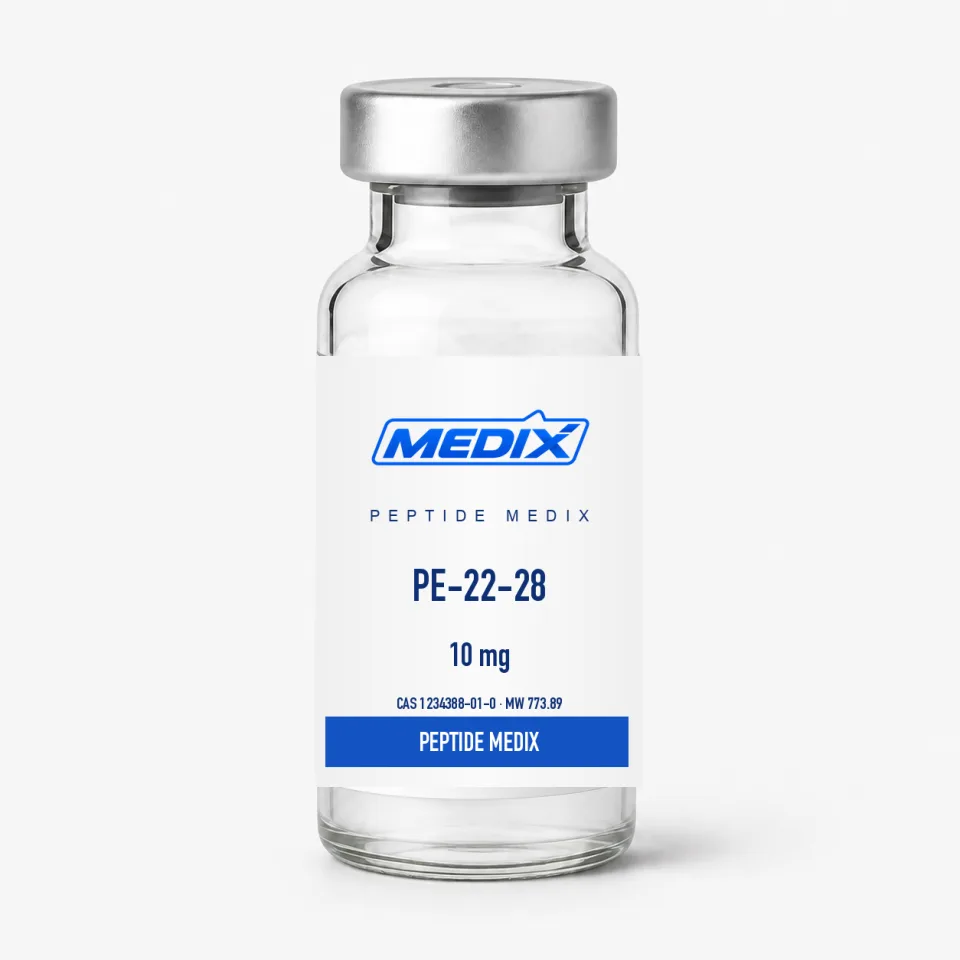
PE-22-28
Heptapeptide derived from spadin, researched as a TREK-1 potassium channel blocker
In stock1 format availableCAS 1234388-01-0
€72
This listing is currently unavailable. Contact us and we will tell you when it is back or suggest an equivalent.
Ask about this listing or request its COA- FormLyophilized white powder in a sealed glass vial
- Mol. weight773.89 g/mol
- Research areasElectrophysiology, mood-related behavioral models, hippocampal neurogenesis and synaptic markers
For laboratory research use only. Sold exclusively for in-vitro laboratory research by qualified professionals. Not for human or veterinary use, and not a medicine, food, cosmetic or dietary supplement. Terms and Conditions
Overview
Key facts
PE-22-28 is a synthetic seven-residue peptide matching positions 22–28 of spadin, a peptide cleaved from the propeptide region of sortilin.
- CAS number
- 1234388-01-0
- Molecular formula
- C35H55N11O9
- Molecular weight
- 773.89 g/mol
- Amino acid sequence
- Gly-Val-Ser-Trp-Gly-Leu-Arg (GVSWGLR), linear with unmodified termini
- Purity
- ≥99% by HPLC; lot-matched COA available
- Form
- Lyophilized white powder in a sealed glass vial
- Storage
- −20 °C, protected from light and moisture
- Available size
- 10 mg
For research use only. Not for human consumption.
PE-22-28 is a synthetic seven-residue peptide matching positions 22–28 of spadin, a peptide cleaved from the propeptide region of sortilin. Spadin drew interest as a natural inhibitor of TREK-1, a two-pore-domain potassium channel that rodent genetic studies have tied to mood regulation. PE-22-28 is the shortened fragment kept after researchers identified which part of spadin was responsible for blocking the channel.
Peptide Medix EU sells PE-22-28 as a 10 mg lyophilised vial for lab research — patch-clamp and receptor assays, analytical method development and authorised animal studies. Every lot is HPLC-purified and identity-confirmed by mass spectrometry, and its certificate of analysis is available on request. Shipped from our EU warehouse. It is a research chemical, not a medicine, supplement or consumer product.
Specifications
Identity
- CAS number
- 1234388-01-0
- Molecular formula
- C35H55N11O9
- Molecular weight
- 773.89 g/mol
- Amino acid sequence
- Gly-Val-Ser-Trp-Gly-Leu-Arg (GVSWGLR), linear with unmodified termini
- Peptide class
- Synthetic heptapeptide ion-channel blocker fragment
Supply & purity
- Form
- Lyophilized white powder in a sealed glass vial
- Purity
- ≥99% by HPLC; lot-matched COA available
- Solubility
- Soluble in bacteriostatic water and sterile water
Handling & storage
- Storage (lyophilized)
- −20 °C, protected from light and moisture
- Storage (reconstituted)
- 2–8 °C; aliquot to avoid repeated freeze-thaw
Additional detail
- Available size
- 10 mg
- Primary research target
- TREK-1 (KCNK2) two-pore-domain potassium channel
- Research areas
- Electrophysiology, mood-related behavioral models, hippocampal neurogenesis and synaptic markers
Questions about PE-22-28
Which larger peptide is PE-22-28 taken from?
It matches residues 22 to 28 of spadin, which arises from the propeptide part of sortilin. Researchers pared spadin down to this heptapeptide while pinpointing, in electrophysiology assays, which section carried the TREK-1-blocking activity.
Has an independent laboratory tested it?
Yes. Reversed-phase HPLC determines purity and mass spectrometry identity for every lot, and the lot certificate — with purity, observed mass and analysis date for the exact batch shipped — is available on request.
What is TREK-1, and why does it attract research?
TREK-1 is a two-pore-domain background potassium channel encoded by KCNK2. Rodent genetics linked its absence to a mood-related behavioural phenotype, making pharmacological blockade a live research question and spadin-derived fragments useful lab tools.
How stable is it once dissolved?
As a short linear peptide with unprotected ends, it is more vulnerable to exopeptidases than acetylated or amidated analogues. Refrigerate reconstituted material at 2–8 °C, split it into single-use aliquots and keep working samples cold during assays.
In what quantity is it supplied?
A single 10 mg lyophilised vial — usually enough for a complete concentration–response series in cell-based electrophysiology, with some left for analytical confirmation.
Related