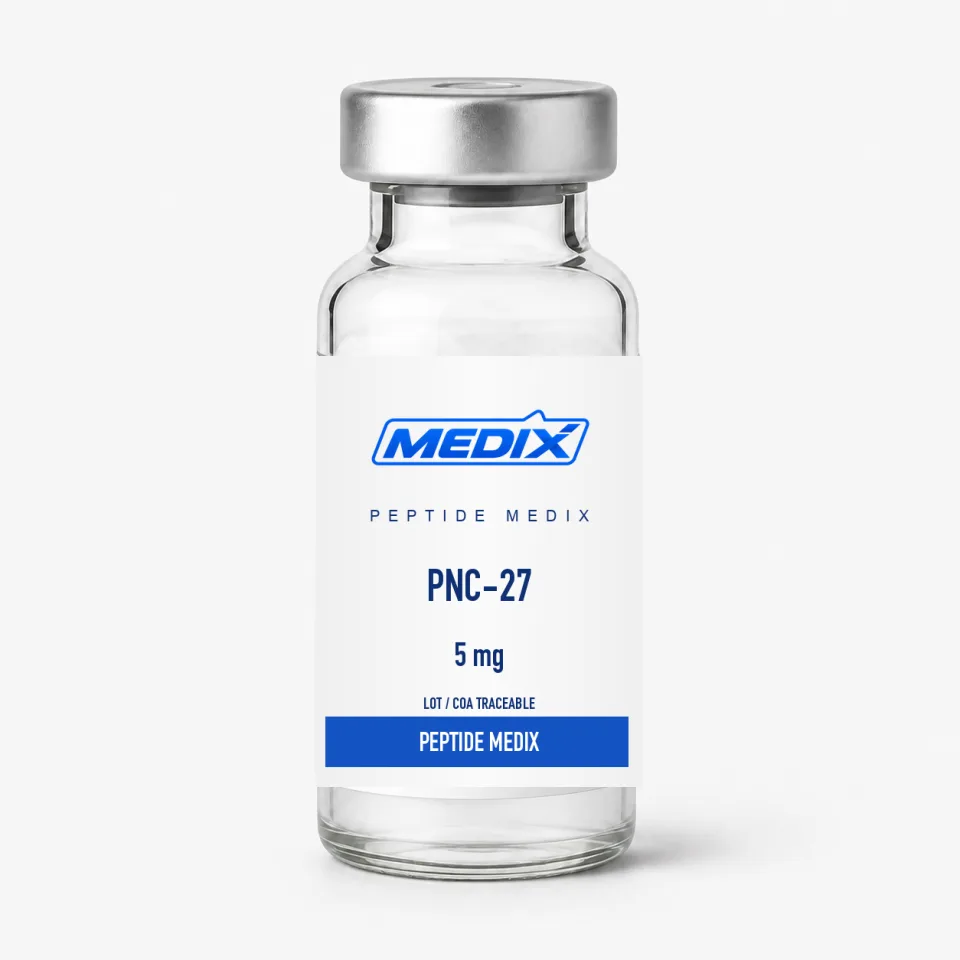
- HPLC purity ≥99%, with a COA for each lot on request
- Certificate of analysis tied to your lot number
- Tracked EU delivery, dispatched the next working day
PNC-27
Chimeric 32-residue peptide from p53 joined to a membrane-resident domain
In stock2 formats available
€97Range €97 – €165
This listing is currently unavailable. Contact us and we will tell you when it is back or suggest an equivalent.
Ask about this listing or request its COA- FormLyophilized powder, sealed glass vial with flip-off seal
- Research areasp53–HDM-2 interaction, membrane pore formation, necrosis versus apoptosis in transformed cell lines
For laboratory research use only. Sold exclusively for in-vitro laboratory research by qualified professionals. Not for human or veterinary use, and not a medicine, food, cosmetic or dietary supplement. Terms and Conditions
Overview
Key facts
PNC-27 is a synthetic hybrid peptide, 32 amino acids long, stitched together from two working parts.
- Amino acid sequence
- Pro-Pro-Leu-Ser-Gln-Glu-Thr-Phe-Ser-Asp-Leu-Trp-Lys-Leu-Leu-Lys-Lys-Tr…
- Purity
- ≥99% by HPLC; lot-matched COA available
- Form
- Lyophilized powder, sealed glass vial with flip-off seal
- Storage
- −20 °C, sealed and protected from light and moisture
- Available sizes
- 5 mg · 10 mg
For research use only. Not for human consumption.
PNC-27 is a synthetic hybrid peptide, 32 amino acids long, stitched together from two working parts. The first part copies amino acids 12 to 26 of p53, the human tumour-suppressor protein — the stretch that attaches to the oncoprotein HDM-2 (human MDM2). The second part is a membrane-resident peptide (MRP) borrowed from the leader sequence of the HIV-1 protein gp41. Joining them gives a molecule meant to insert itself into a lipid membrane and remain there, with the p53 recognition motif on display.
Pincus, Michl and their colleagues developed it to explore what happens to the p53–HDM-2 interaction when it is forced to take place at the cell membrane rather than inside the nucleus. They reported that HDM-2 can be found in the outer membrane of transformed (cancer-like) cell lines but not in the corresponding normal lines, and PNC-27 has since served in cell culture as a probe of that difference.
Specifications
Identity
- Amino acid sequence
- Pro-Pro-Leu-Ser-Gln-Glu-Thr-Phe-Ser-Asp-Leu-Trp-Lys-Leu-Leu-Lys-Lys-Trp-Lys-Met-Arg-Arg-Asn-Gln-Phe-Trp-Val-Lys-Val-Gln-Arg-Gly
- Chain length
- 32 amino acids (chimeric construct)
- Peptide class
- Chimeric p53-derived membrane-active research peptide
Supply & purity
- Form
- Lyophilized powder, sealed glass vial with flip-off seal
- Purity
- ≥99% by HPLC; lot-matched COA available
- Available sizes
- 5 mg, 10 mg
- Solubility
- Sterile or bacteriostatic water; dilute aqueous buffers for assay work
Handling & storage
- Storage (lyophilized)
- −20 °C, sealed and protected from light and moisture
- Storage (reconstituted)
- 2–8 °C, protected from light; use within the study window
Additional detail
- Domain 1
- p53 residues 12–26 — the HDM-2 binding region
- Domain 2
- Membrane-resident peptide (MRP) from the HIV-1 gp41 leader sequence
- Molecular target studied
- HDM-2 (human MDM2), including membrane-associated pools
- Related analogue
- PNC-28, which uses p53 residues 17–26 with the same MRP
- Research areas
- p53–HDM-2 interaction, membrane pore formation, necrosis versus apoptosis in transformed cell lines
Questions about PNC-27
What are the building blocks of PNC-27?
A single chain of 32 residues in two parts: amino acids 12–26 of p53, which make up the site that binds HDM-2, and a membrane-anchoring peptide taken from the start of HIV-1 gp41. The anchoring half fixes the molecule in lipid membranes, so the p53 motif is presented right at the membrane.
How does PNC-27 compare with PNC-28?
They carry the identical membrane-anchoring segment but differ in the piece of p53 attached — residues 12–26 for PNC-27, the shorter 17–26 for PNC-28. Both are used in the same experiments, and researchers often test them together to find out how long the p53 portion needs to be.
Is it independently tested, with a COA?
Yes. An independent lab HPLC-analyses every lot to confirm ≥99% purity and runs identity tests, and the Certificate of Analysis for your batch is available. Make sure the vial's lot number matches it before logging data.
What are the storage and reconstitution steps?
Freeze the dry powder at −20 °C, protected from light and damp. To dissolve it, let sterile or bacteriostatic water run gently down the inside of the vial and don't shake; then keep the solution in the fridge (2–8 °C) and use it within the period you have validated for your study.
Does PNC-27 destroy cancer cells?
Cell-culture studies report rapid membrane disruption and non-apoptotic cell death in several cancer-derived lines, with weaker effects on untransformed controls. These are lab observations in particular systems, not proof of a therapy, and independent confirmation is still scarce.