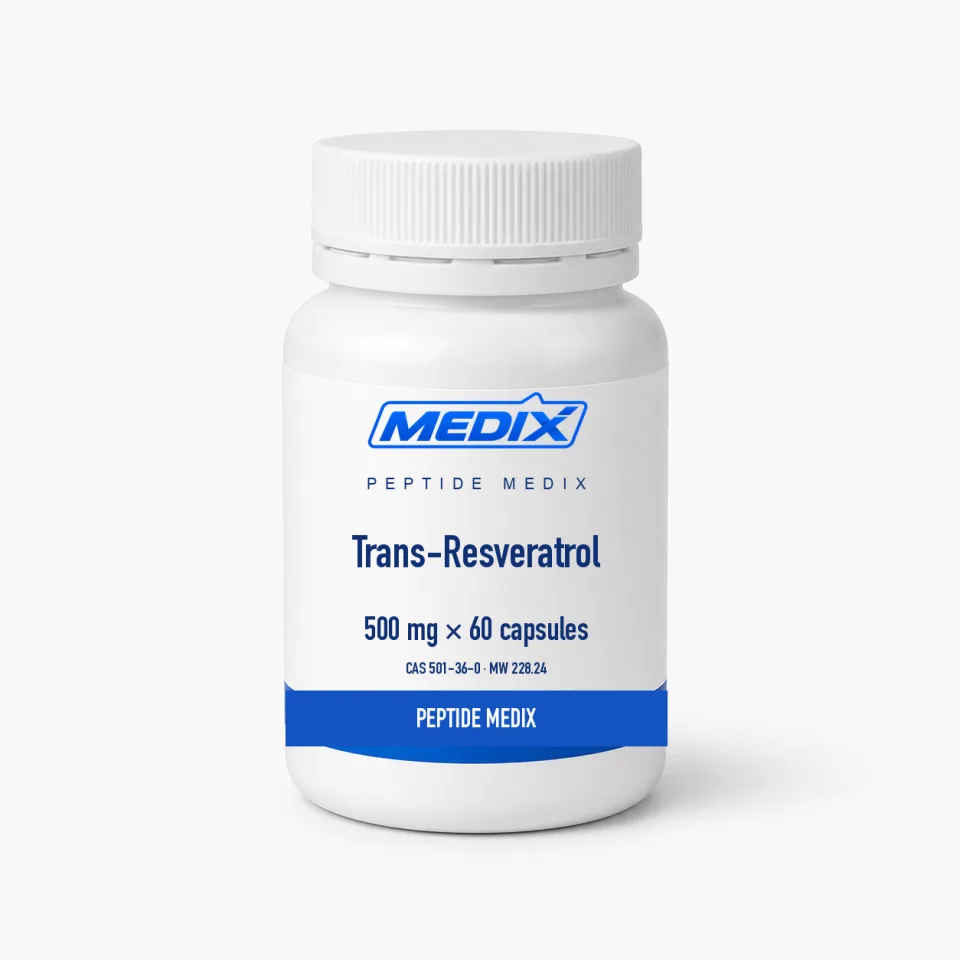
- trans-Resveratrol content ≥98% (HPLC); per-lot COA on request
- Certificate of analysis tied to your lot number
- Tracked EU delivery, dispatched the next working day
Trans-Resveratrol
trans-Resveratrol, a stilbenoid polyphenol for sirtuin and longevity research
In stock1 format availableCAS 501-36-0
€38
This listing is currently unavailable. Contact us and we will tell you when it is back or suggest an equivalent.
Ask about this listing or request its COA- FormOff-white to light tan powder in vegetarian capsules, sealed bottle
- Mol. weight228.24 g/mol
- Research areasSIRT1 and sirtuin biology, AMPK signalling, oxidative stress, cellular senescence, xenohormesis
For laboratory research use only. Sold exclusively for in-vitro laboratory research by qualified professionals. Not for human or veterinary use, and not a medicine, food, cosmetic or dietary supplement. Terms and Conditions
Overview
Key facts
trans-Resveratrol (3,5,4'-trihydroxy-trans-stilbene) is a polyphenol of the stilbene class that grapevines, Japanese knotweed and other plants produce as a phytoalexin — a defensive substance made when they are attacked by fungi or stressed.
- CAS number
- 501-36-0
- Molecular formula
- C14H12O3
- Molecular weight
- 228.24 g/mol
- Purity
- ≥98% trans-resveratrol by HPLC; lot-matched COA available
- Form
- Off-white to light tan powder in vegetarian capsules, sealed bottle
- Storage
- Cool, dry place, sealed and protected from light; refrigeration extends shelf life
- Available size
- 500 mg · 60 capsules
For research use only. Not for human consumption.
trans-Resveratrol (3,5,4'-trihydroxy-trans-stilbene) is a polyphenol of the stilbene class that grapevines, Japanese knotweed and other plants produce as a phytoalexin — a defensive substance made when they are attacked by fungi or stressed. Material sold commercially is mostly obtained from the roots of Polygonum cuspidatum or produced synthetically. Only the trans form really matters: the cis form has had much less study and appears readily once UV light hits the molecule — hence resveratrol products are kept away from light.
Resveratrol became a fixture in longevity research once studies claimed it activated SIRT1, an NAD-dependent deacetylase, and prolonged life in yeast and invertebrates. That view has been contested ever since: considerable evidence suggests the first assay depended on a substrate tagged with a fluorophore, and other or additional mechanisms — AMPK activation, inhibition of phosphodiesterases, direct antioxidant chemistry — have been proposed. The very controversy helps explain why resveratrol is still such a common research standard.
Specifications
Identity
- CAS number
- 501-36-0
- Molecular formula
- C14H12O3
- Molecular weight
- 228.24 g/mol
Supply & purity
- Form
- Off-white to light tan powder in vegetarian capsules, sealed bottle
- Purity
- ≥98% trans-resveratrol by HPLC; lot-matched COA available
- Solubility
- Poorly water soluble; soluble in ethanol and DMSO for stock preparation
Additional detail
- Available size
- 500 mg × 60 capsules
- Chemical name
- 3,5,4'-trihydroxy-trans-stilbene
- Chemical class
- Stilbenoid polyphenol (phytoalexin)
- Isomerism
- Trans form; converts to the cis isomer on UV exposure
- Research areas
- SIRT1 and sirtuin biology, AMPK signalling, oxidative stress, cellular senescence, xenohormesis
- Storage
- Cool, dry place, sealed and protected from light; refrigeration extends shelf life
- Stability note
- Sensitive to light, oxygen and alkaline pH
Questions about Trans-Resveratrol
Why the trans form in particular?
Nearly all published studies use the trans form, which predominates in nature and has been characterised far more thoroughly. UV light turns it into the cis form, which acts differently in several assays, so we specify, store and ship the material in a way that keeps it trans.
Can I obtain a certificate of analysis?
Yes. HPLC testing is done on each lot, and the COA gives the trans-resveratrol content and confirms identity. Quote the lot number to request it and keep it with your lab records — the purity of polyphenols differs greatly between sources, and that affects whether results can be compared.
How is it prepared for cell culture?
It barely dissolves in water, so labs usually prepare a concentrated stock in DMSO or ethanol and add it to the medium just before use. Make sure every group in the experiment — including the vehicle controls — ends up with the same final amount of solvent.
Where does resveratrol sit compared with NMN and fisetin?
All three turn up in ageing research, but they work through different chemistry. NMN feeds NAD+ directly as a precursor; fisetin, a flavonoid, is mainly tested for senolytic activity; resveratrol, a stilbene, is investigated for its effects on sirtuin and AMPK signalling. Labs often test them side by side as a panel.
Why do published findings vary so widely?
Outcomes depend strongly on concentration, organism, strain and formulation, and many in vitro studies use concentrations well above those reached in whole organisms, since resveratrol is quickly conjugated after absorption. Always state the model and concentration explicitly when reporting.
Related