- HPLC assay on every lot; COA on request
- Certificate of analysis tied to your lot number
- Tracked EU delivery, dispatched the next working day
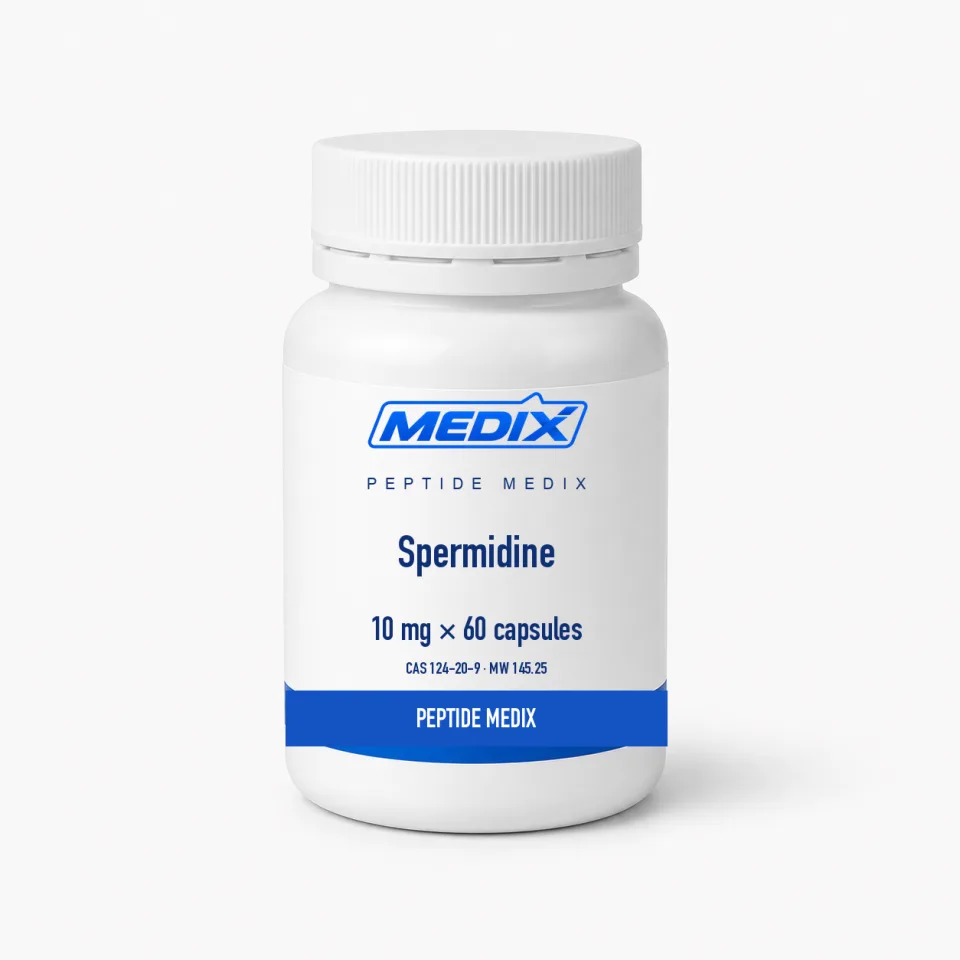
Spermidine
Naturally occurring polyamine researched for autophagy and cellular-ageing endpoints
In stock1 format availableCAS 124-20-9
€46
This listing is currently unavailable. Contact us and we will tell you when it is back or suggest an equivalent.
Ask about this listing or request its COA- FormOral capsule, sealed bottle with tamper-evident closure and desiccant
- Mol. weight145.25 g/mol
- Research areasAutophagy induction, cellular senescence, cardiac and neuronal ageing models, translation control
For laboratory research use only. Sold exclusively for in-vitro laboratory research by qualified professionals. Not for human or veterinary use, and not a medicine, food, cosmetic or dietary supplement. Terms and Conditions
Overview
Key facts
Spermidine is a natural polyamine — a small, flexible triamine (C7H19N3, 145.25 g/mol, CAS 124-20-9) found in every living cell.
- CAS number
- 124-20-9
- Molecular formula
- C7H19N3
- Molecular weight
- 145.25 g/mol
- Purity
- Assayed by HPLC; lot-matched COA available
- Form
- Oral capsule, sealed bottle with tamper-evident closure and desiccant
- Storage
- Room temperature or cooler, sealed and dry, protected from light
- Available size
- 10 mg · 60 capsules
For research use only. Not for human consumption.
Spermidine is a natural polyamine — a small, flexible triamine (C7H19N3, 145.25 g/mol, CAS 124-20-9) found in every living cell. Spermidine synthase makes it from putrescine, using decarboxylated S-adenosylmethionine as the aminopropyl donor, and it also comes from foods such as wheat germ, soybeans and natto, mature cheese, mushrooms and pulses. Several species show falling tissue polyamine levels with age — a major reason longevity researchers are interested.
Its best-characterised job at the molecular level involves no receptor. Spermidine is the only possible donor for hypusination, a rare modification made after translation that switches on eIF5A (eukaryotic translation initiation factor 5A); since no other molecule can provide the required aminobutyl group, eIF5A only works when spermidine is available. Beyond this, studies describe spermidine inhibiting acetyltransferases and triggering autophagy in yeast, flies, worms and mammalian cells.
Specifications
Identity
- CAS number
- 124-20-9
- Molecular formula
- C7H19N3
- Molecular weight
- 145.25 g/mol
Supply & purity
- Form
- Oral capsule, sealed bottle with tamper-evident closure and desiccant
- Purity
- Assayed by HPLC; lot-matched COA available
- Solubility
- Freely soluble in water; free base is hygroscopic and air-sensitive
Additional detail
- Content per capsule
- 10 mg spermidine
- Available count
- 60 capsules
- Chemical class
- Biogenic polyamine (triamine)
- IUPAC name
- N-(3-aminopropyl)butane-1,4-diamine
- Biosynthesis
- Formed from putrescine by spermidine synthase; precursor to spermine
- Molecular role
- Exclusive substrate for hypusination of eIF5A; reported acetyltransferase inhibition
- Research areas
- Autophagy induction, cellular senescence, cardiac and neuronal ageing models, translation control
- Storage
- Room temperature or cooler, sealed and dry, protected from light
- Preparation required
- None — fixed unit content, no reconstitution step
Questions about Spermidine
What is spermidine?
A polyamine that occurs naturally in all cells and in many foods — wheat germ, natto, mature cheese and pulses among them. Chemically a small triamine (C7H19N3), it is made from putrescine and is the precursor of spermine in the polyamine pathway.
Why is it of interest to longevity research?
Giving spermidine has been reported to trigger autophagy and to extend lifespan in yeast, nematodes and fruit flies, and these effects disappear when autophagy genes are knocked out. In several species polyamine content in tissues also falls as animals age — so it is an obvious subject for ageing research.
What does hypusination mean?
A rare change made to a protein after it is built: the aminobutyl portion of spermidine is added to one lysine of eIF5A and later hydroxylated, producing hypusine. No other known protein carries hypusine, and spermidine is the sole donor, so translation of certain motifs depends directly on the supply of polyamines.
Is there a certificate of analysis?
Yes. Each lot's identity and content are measured, and you can ask for the certificate bearing the lot number printed on your bottle. As polyamines attract moisture, checking content by assay — not by how the capsules look — is what tells you about quality.
How are the capsules stored?
Keep them in the closed original bottle with the desiccant, at room temperature or below, protected from light and damp. Never transfer capsules to an open container, and throw away any that have gone soft, changed colour or stuck to one another.
Where does spermidine sit compared with NMN and fisetin?
Their pathways differ: NMN feeds NAD+ salvage, fisetin is a flavonoid researched for senolytic activity, and spermidine is studied chiefly for inducing autophagy and for its role as the eIF5A substrate. Longevity labs frequently give each one its own study arm to keep the mechanisms apart.
Related