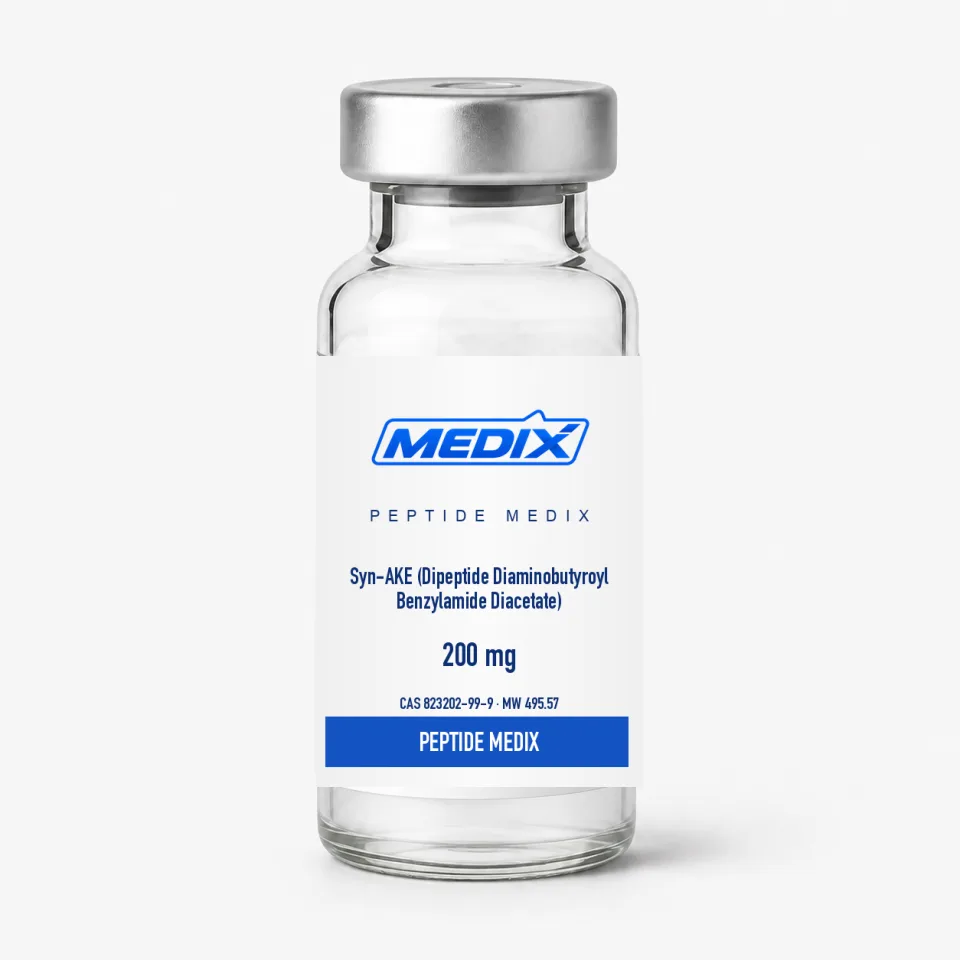
- HPLC purity ≥99%, with a COA for each lot on request
- Certificate of analysis tied to your lot number
- Tracked EU delivery, dispatched the next working day
Syn-AKE (Dipeptide Diaminobutyroyl Benzylamide Diacetate)
Modified dipeptide diacetate researched in nicotinic-receptor models
In stock1 format availableCAS 823202-99-9
€178
This listing is currently unavailable. Contact us and we will tell you when it is back or suggest an equivalent.
Ask about this listing or request its COA- FormLyophilized diacetate salt, sealed glass vial
- Mol. weight495.57 g/mol as the diacetate
- Research areasNicotinic acetylcholine receptor models, contraction-frequency assays and cosmetic-peptide formulation
For laboratory research use only. Sold exclusively for in-vitro laboratory research by qualified professionals. Not for human or veterinary use, and not a medicine, food, cosmetic or dietary supplement. Terms and Conditions
Overview
Key facts
Syn-AKE was conceived as a compact analogue building on studies of waglerin-1.
- CAS number
- 823202-99-9
- Molecular formula
- C23H37N5O7, including two acetate molecules
- Molecular weight
- 495.57 g/mol as the diacetate
- Purity
- ≥99% by HPLC; lot-matched COA available
- Form
- Lyophilized diacetate salt, sealed glass vial
- Storage
- −20 °C lyophilized, protected from light and moisture
- Available size
- 200 mg
For research use only. Not for human consumption.
Syn-AKE was conceived as a compact analogue building on studies of waglerin-1. Lab and formulation reports describe it reversibly antagonising nicotinic acetylcholine receptors in model systems and altering how often innervated cells in culture contract. The data are sparse, however, and results obtained with waglerin-1 — a venom peptide of 22 residues — cannot simply be assumed for this far smaller molecule without measuring them directly.
Because it is supplied as a diacetate salt, two acetate counter-ions make up part of every milligram you weigh. The same weighed amount therefore contains less of the free base than it would for a peptide without counter-ions, and any quantitative protocol must specify whether a stated concentration refers to the salt or the base. The benzylamide at the C-terminus carries no charge and is fairly lipophilic, while the diaminobutyric-acid side chain is basic; together they give the molecule a mixed solubility that you should check experimentally in each vehicle instead of predicting it from the formula.
Specifications
Identity
- CAS number
- 823202-99-9
- Molecular formula
- C23H37N5O7, including two acetate molecules
- Molecular weight
- 495.57 g/mol as the diacetate
Supply & purity
- Form
- Lyophilized diacetate salt, sealed glass vial
- Purity
- ≥99% by HPLC; lot-matched COA available
Additional detail
- Available size
- 200 mg
- Structural notation
- beta-Ala-Pro-Dab-NH-benzyl · 2 acetate
- INCI name
- Dipeptide Diaminobutyroyl Benzylamide Diacetate
- Also known as
- Syn-AKE, Syn-Ake acetate, snake peptide diacetate
- Compound class
- Modified peptide-like diaminobutyroyl benzylamide salt
- Research areas
- Nicotinic acetylcholine receptor models, contraction-frequency assays and cosmetic-peptide formulation
- Storage
- −20 °C lyophilized, protected from light and moisture
Questions about Syn-AKE (Dipeptide Diaminobutyroyl Benzylamide Diacetate)
What is Syn-AKE's exact chemical name?
The INCI designation is Dipeptide Diaminobutyroyl Benzylamide Diacetate. Its core structure is beta-Ala-Pro-Dab-NH-benzyl, accompanied by two acetate ions, and it is registered as CAS 823202-99-9.
Is it the same as waglerin-1?
No. Waglerin-1 is a snake-venom peptide 22 residues long, while Syn-AKE is a far more compact synthetic molecule modelled on just one finding from waglerin research. The two differ in size, sequence, evidence on selectivity and analytical identity.
How is it different from Vialox?
Vialox is a plain pentapeptide with the sequence Gly-Pro-Arg-Pro-Ala, whereas Syn-AKE is a chemically modified dipeptide-derived compound (a diaminobutyroyl benzylamide) sold as its diacetate. Both come up in studies of muscle contraction, but they are distinct compounds thought to act on receptors in different ways.
Which purity documents are available?
Each lot of the diacetate is HPLC-tested to a minimum of 99% and comes with its own certificate. When calculating molar amounts, base them on the salt form given in that certificate.
Related