- HPLC purity ≥99%, with a COA for each lot on request
- Certificate of analysis tied to your lot number
- Tracked EU delivery, dispatched the next working day
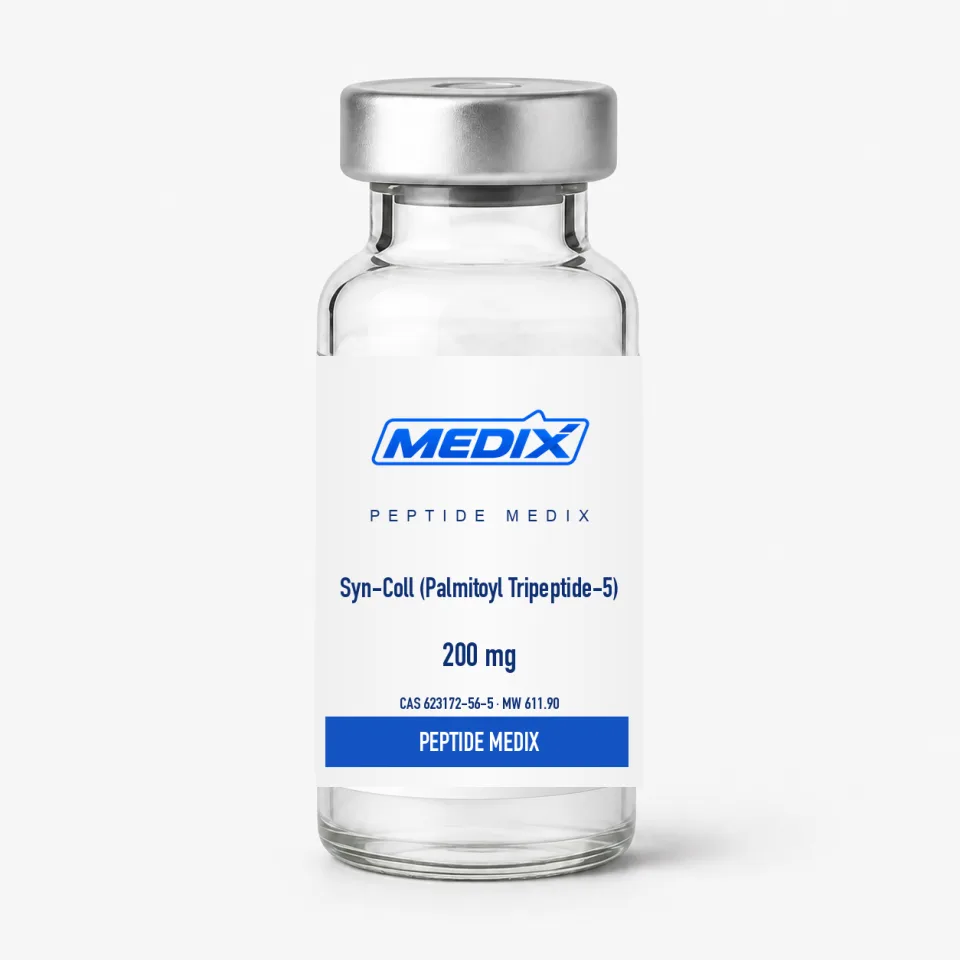
Syn-Coll (Palmitoyl Tripeptide-5)
Pal-KVK signal tripeptide for TGF-β and extracellular-matrix model research
In stock1 format availableCAS 623172-56-5
€178
This listing is currently unavailable. Contact us and we will tell you when it is back or suggest an equivalent.
Ask about this listing or request its COA- FormLyophilized amphiphilic peptide powder, sealed glass vial
- Mol. weight611.90 g/mol as the free peptide
- Research areasTGF-beta signaling, fibroblast matrix output, collagen-associated markers and matrix-metalloproteinase models
For laboratory research use only. Sold exclusively for in-vitro laboratory research by qualified professionals. Not for human or veterinary use, and not a medicine, food, cosmetic or dietary supplement. Terms and Conditions
Overview
Key facts
Syn-Coll is the name under which Palmitoyl Tripeptide-5 is commonly traded: the tripeptide Lys-Val-Lys carrying a fatty acid, abbreviated Pal-KVK.
- CAS number
- 623172-56-5
- Molecular formula
- C33H65N5O5
- Molecular weight
- 611.90 g/mol as the free peptide
- Amino acid sequence
- Palmitoyl-Lys-Val-Lys-OH (Pal-KVK)
- Purity
- ≥99% by HPLC; lot-matched COA available
- Form
- Lyophilized amphiphilic peptide powder, sealed glass vial
- Storage
- −20 °C lyophilized, protected from light and moisture
- Available size
- 200 mg
For research use only. Not for human consumption.
Syn-Coll is the name under which Palmitoyl Tripeptide-5 is commonly traded: the tripeptide Lys-Val-Lys carrying a fatty acid, abbreviated Pal-KVK. A 16-carbon chain on its N-terminus makes it amphiphilic, and its two basic lysines give it a charge and formulation behaviour quite unlike other palmitoylated signal peptides — Pal-GHK or Pal-GQPR, for example.
It was developed for research on the extracellular matrix, focusing on TGF-β (transforming growth factor beta) signalling and collagen-related measures. Published work and supplier documentation have examined matrix production by fibroblasts, the activation of latent TGF-β and markers of matrix metalloproteinases — yet a large share of that evidence is commercial or specific to particular formulations, so claiming an effect for Pal-KVK requires your own analytical checks and single-ingredient controls.
Each research vial holds 200 mg of Palmitoyl Tripeptide-5 (C33H65N5O5, 611.90 g/mol), tested by HPLC and backed by a certificate for its lot. It is raw material, not a finished cosmetic, and we supply it only for laboratory work on formulations and cell models.
Comparing it with other fatty-acid-modified peptides is informative, but needs care. Matrixyl is palmitoyl pentapeptide-4, built on the sequence KTTKS; Pal-GHK carries the copper-binding GHK motif; and Pal-GQPR is a separate tetrapeptide — sharing a C16 chain does not give them a common mechanism. Pal-KVK's lysine-rich core also behaves differently in negatively charged systems, so a vehicle that works for one palmitoylated peptide has to be tested again for this one rather than assumed to work.
Specifications
Identity
- CAS number
- 623172-56-5
- Molecular formula
- C33H65N5O5
- Molecular weight
- 611.90 g/mol as the free peptide
- Peptide class
- Lipidated signal tripeptide
Supply & purity
- Form
- Lyophilized amphiphilic peptide powder, sealed glass vial
- Purity
- ≥99% by HPLC; lot-matched COA available
- Solubility
- Low water solubility; validate a co-solvent or surfactant vehicle
Additional detail
- Available size
- 200 mg
- Sequence
- Palmitoyl-Lys-Val-Lys-OH (Pal-KVK)
- Also known as
- Syn-Coll, Syn-Coll peptide, Palmitoyl Tripeptide-5
- Research areas
- TGF-beta signaling, fibroblast matrix output, collagen-associated markers and matrix-metalloproteinase models
- Storage
- −20 °C lyophilized, protected from light and moisture
Questions about Syn-Coll (Palmitoyl Tripeptide-5)
What sequence does Syn-Coll have?
Palmitoyl-Lys-Val-Lys-OH — Pal-KVK — listed as Palmitoyl Tripeptide-5, with a molecular weight of 611.90 g/mol for the free peptide.
Are Syn-Coll and Matrixyl the same?
No. Matrixyl usually refers to Palmitoyl Pentapeptide-4 (Pal-KTTKS), whereas Syn-Coll is Palmitoyl Tripeptide-5 (Pal-KVK). They are different compounds needing separate listings and controls.
Is it identical to Palmitoyl Tripeptide-1?
No — Palmitoyl Tripeptide-1 is Pal-GHK, and this product is Pal-KVK. They use the same lipidation approach but differ in sequence and research rationale.
Why might a co-solvent be needed?
The 16-carbon palmitoyl chain makes it hard to dissolve in water on its own and encourages it to stick to surfaces or clump together. Adding a co-solvent or surfactant — and recording which — can make results more reproducible, provided your controls contain the same vehicle.
Related