- HPLC-assayed purity of ≥99%
- Certificate of analysis tied to your lot number
- Tracked EU delivery, dispatched the next working day
Vitamin D3 (Cholecalciferol)
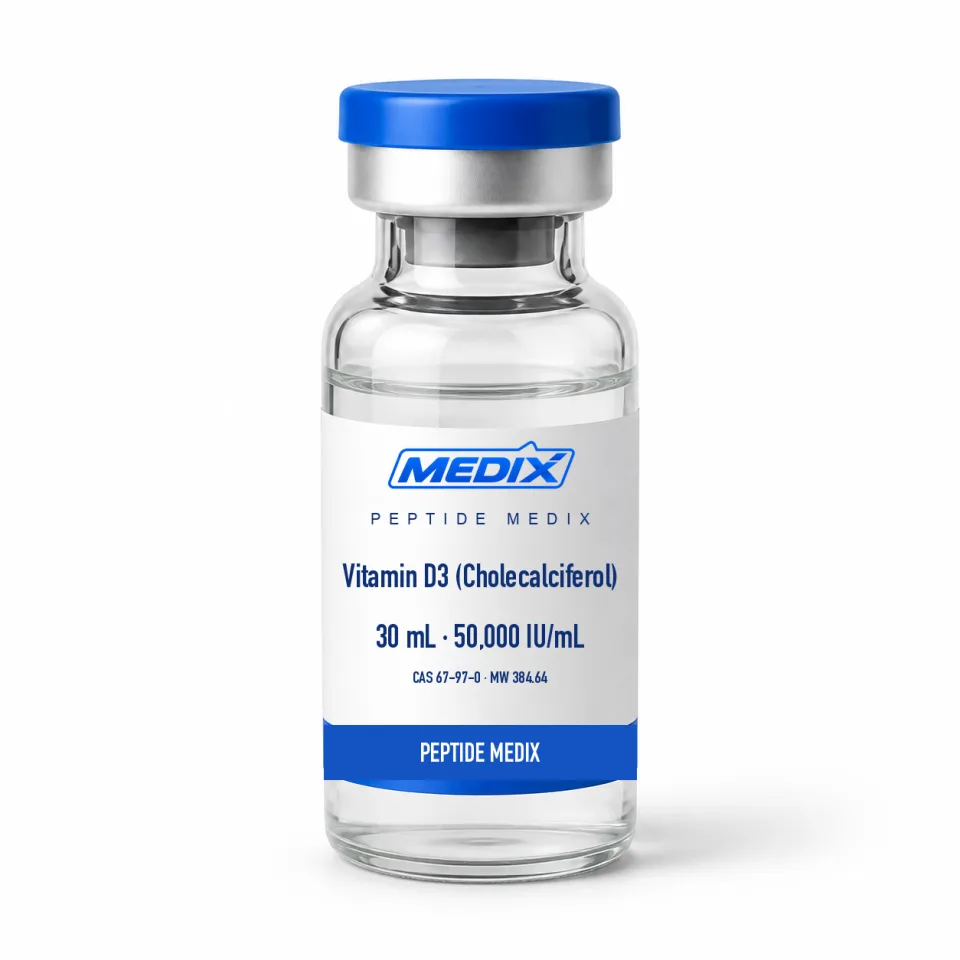
Cholecalciferol solution, 50,000 IU/mL, in a 30 mL vial
In stock1 format availableCAS 67-97-0
€55
This listing is currently unavailable. Contact us and we will tell you when it is back or suggest an equivalent.
Ask about this listing or request its COA- FormOil-miscible solution in a sealed vial
- Mol. weight384.64 g/mol
- Research areasCalcium and phosphate homeostasis, VDR gene regulation, immune cell differentiation, bone biology models
For laboratory research use only. Sold exclusively for in-vitro laboratory research by qualified professionals. Not for human or veterinary use, and not a medicine, food, cosmetic or dietary supplement. Terms and Conditions
Overview
Key facts
Vitamin D3 — cholecalciferol — is a secosteroid: a steroid with a broken B ring, opened here when ultraviolet light photolyses 7-dehydrocholesterol in the skin.
- CAS number
- 67-97-0
- Molecular formula
- C27H44O
- Molecular weight
- 384.64 g/mol
- Form
- Oil-miscible solution in a sealed vial
- Storage
- Controlled room temperature or refrigerated, tightly sealed, protected from light and air
- Available size
- 30 mL · 50,000 IU/mL
For research use only. Not for human consumption.
Vitamin D3 — cholecalciferol — is a secosteroid: a steroid with a broken B ring, opened here when ultraviolet light photolyses 7-dehydrocholesterol in the skin. This open ring gives the molecule its flexible triene and sets it apart from the classic four-ring steroid hormones it otherwise resembles.
Cholecalciferol itself is not the active hormone. The liver first attaches a hydroxyl group at position 25, forming calcifediol (25-hydroxyvitamin D3) — the form measured when vitamin D status is tested in blood. The kidney enzyme CYP27B1 then adds a second hydroxyl at the 1-alpha position, producing calcitriol, which is the ligand that switches on the vitamin D receptor in the cell nucleus. That receptor teams up with RXR and controls hundreds of genes, which is why vitamin D biology reaches well beyond bone into calcium balance, immunology, cell differentiation and gene regulation.
Supplied as a solution containing 50,000 IU per mL, in a vial holding 30 mL. One IU equals 0.025 µg of cholecalciferol, so this works out at 1.25 mg/mL. As the molecule is fat-soluble and easily oxidised, light and air are the main threats to its stability. A Certificate of Analysis is available for every lot.
Specifications
Identity
- CAS number
- 67-97-0
- Molecular formula
- C27H44O
- Molecular weight
- 384.64 g/mol
Supply & purity
- Form
- Oil-miscible solution in a sealed vial
Additional detail
- Concentration
- 50,000 IU/mL (1.25 mg/mL cholecalciferol)
- Vial size
- 30 mL
- Also known as
- Cholecalciferol, vitamin D3, calciol
- Chemical class
- Secosteroid (9,10-secosteroid), fat-soluble vitamin
- IU conversion
- 1 IU = 0.025 µg cholecalciferol; 40,000 IU = 1 mg
- Metabolic pathway
- 25-hydroxylation to calcifediol, then 1-alpha-hydroxylation to calcitriol
- Molecular target
- Nuclear vitamin D receptor (VDR), heterodimerizing with RXR
- Research areas
- Calcium and phosphate homeostasis, VDR gene regulation, immune cell differentiation, bone biology models
- Storage
- Controlled room temperature or refrigerated, tightly sealed, protected from light and air
Questions about Vitamin D3 (Cholecalciferol)
What is vitamin D3?
Cholecalciferol — a secosteroid created when UV light splits the B ring of 7-dehydrocholesterol. It is the precursor of calcifediol and of calcitriol, the hormone that switches on the nuclear vitamin D receptor.
How much cholecalciferol does 50,000 IU represent?
1.25 mg — since each IU equals 0.025 µg. At 50,000 IU per mL, the solution therefore holds 1.25 mg/mL, and a full 30 mL vial contains 37.5 mg altogether.
Is cholecalciferol the active form?
No — it must be hydroxylated twice: in the liver to calcifediol, then in the kidney to calcitriol, the form that activates the receptor. In vitro receptor-activation studies therefore usually use calcitriol rather than cholecalciferol.
How should the solution be handled?
Keep the vial closed and away from light, minimise air space and temperature swings, and use a compatible organic carrier when diluting for aqueous work. Light, oxygen and heat all attack the conjugated triene, causing isomerisation and oxidation.
Is each lot tested?
Yes. Every lot comes with its own Certificate of Analysis covering identity, concentration and purity, which you can review before buying to check the material against your acceptance criteria.