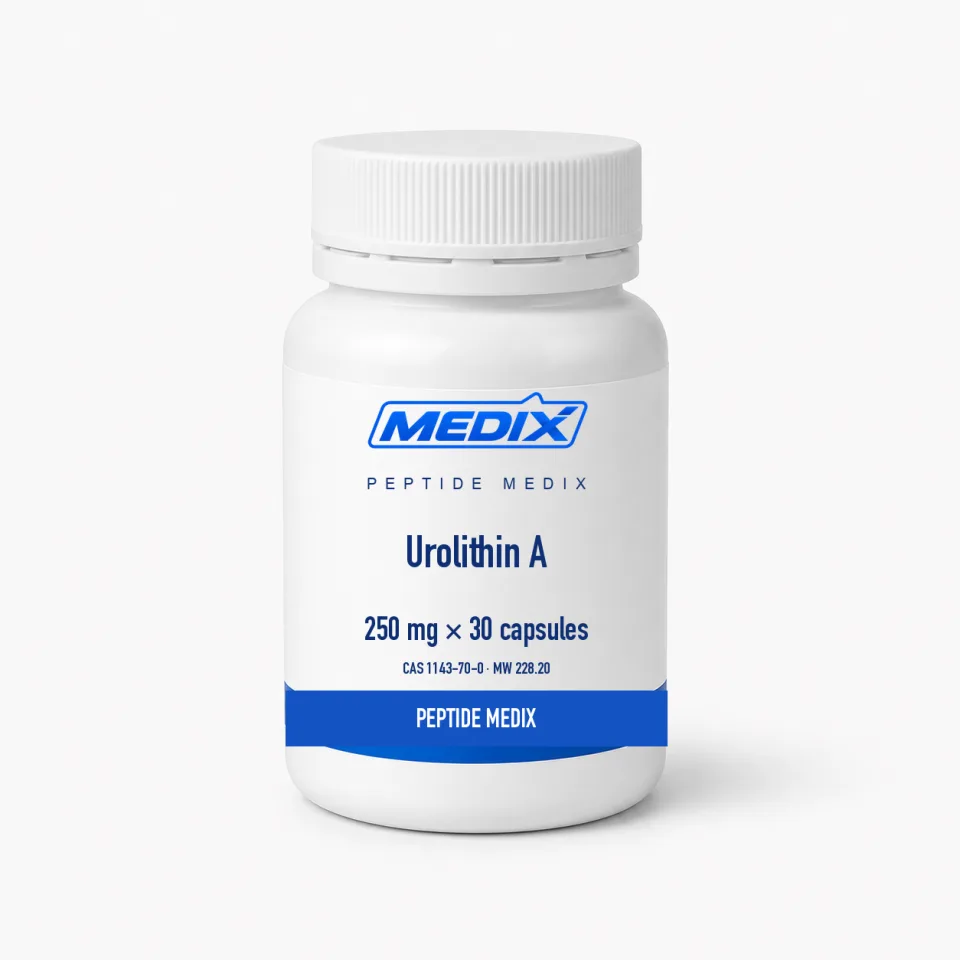
- HPLC purity ≥98%, with a COA for each lot on request
- Certificate of analysis tied to your lot number
- Tracked EU delivery, dispatched the next working day
Urolithin A
Microbial metabolite of ellagitannins, researched in mitophagy studies
In stock1 format availableCAS 1143-70-0
€55
This listing is currently unavailable. Contact us and we will tell you when it is back or suggest an equivalent.
Ask about this listing or request its COA- FormOff-white to pale beige crystalline powder in capsules; sealed bottle with desiccant
- Mol. weight228.20 g/mol
- Research areasMitophagy, mitochondrial biogenesis and quality control, skeletal muscle function, cellular senescence, inflammation models
For laboratory research use only. Sold exclusively for in-vitro laboratory research by qualified professionals. Not for human or veterinary use, and not a medicine, food, cosmetic or dietary supplement. Terms and Conditions
Overview
Key facts
Urolithin A is a small dibenzopyranone: 3,8-dihydroxy-urolithin, CAS 1143-70-0, C13H8O4, 228.20 g/mol.
- CAS number
- 1143-70-0
- Molecular formula
- C13H8O4
- Molecular weight
- 228.20 g/mol
- Purity
- ≥98% by HPLC; lot-matched COA available
- Form
- Off-white to pale beige crystalline powder in capsules; sealed bottle with desiccant
- Storage
- Room temperature or cooler, sealed, protected from light and moisture
- Available size
- 250 mg · 30 capsules
For research use only. Not for human consumption.
Urolithin A is a small dibenzopyranone: 3,8-dihydroxy-urolithin, CAS 1143-70-0, C13H8O4, 228.20 g/mol. Foods don't contain it as such — it is made in the large intestine when gut bacteria break down ellagitannins and ellagic acid, polyphenols found in pomegranates, walnuts and certain berries. Only some people carry gut microbes capable of this conversion, so in practice research has turned from the dietary starting materials to the metabolite itself.
It entered ageing research after studies reported that it triggers mitophagy — the targeted autophagic removal of damaged mitochondria — in C. elegans and in rodent muscle. As build-up of faulty mitochondria is a common hallmark of ageing tissue, a small molecule seemingly able to speed their turnover became a popular tool for investigating mitochondrial quality control, alongside PINK1/Parkin signalling and markers of mitochondrial biogenesis.
Specifications
Identity
- CAS number
- 1143-70-0
- Molecular formula
- C13H8O4
- Molecular weight
- 228.20 g/mol
Supply & purity
- Form
- Off-white to pale beige crystalline powder in capsules; sealed bottle with desiccant
- Purity
- ≥98% by HPLC; lot-matched COA available
- Available sizes
- 250 mg × 30 capsules
- Solubility
- Poorly water-soluble; stocks are commonly prepared in DMSO for cell work
Additional detail
- Chemical name
- 3,8-dihydroxy-6H-dibenzo[b,d]pyran-6-one (3,8-dihydroxyurolithin)
- Chemical class
- Dibenzopyranone (urolithin) polyphenol metabolite
- Biological origin
- Colonic bacterial metabolism of ellagitannins and ellagic acid from pomegranate, walnuts and berries
- Research areas
- Mitophagy, mitochondrial biogenesis and quality control, skeletal muscle function, cellular senescence, inflammation models
- Metabolism note
- Extensively conjugated to glucuronide and sulfate forms in vivo, which analytical methods usually quantify alongside the free aglycone
- Storage
- Room temperature or cooler, sealed, protected from light and moisture
Questions about Urolithin A
Does pomegranate contain Urolithin A?
Not as such. Pomegranate, walnuts and certain berries provide ellagitannins and ellagic acid, which bacteria in the colon turn into urolithins. Human studies show that only some individuals have the microbial capacity to make urolithin A efficiently — hence research uses the isolated metabolite.
Where is it mostly used in research?
Mitochondrial quality control. It became widely used after studies in worms and in the muscles of rodents found that it triggers mitophagy — the targeted removal of damaged mitochondria — and it is now studied in models ranging from mitochondrial and muscle function to cellular ageing and inflammation.
Which purity documents are supplied?
HPLC testing to at least 98% is done on every lot, and each has a certificate of analysis that includes an identity check. When you ask for it, please give the lot number shown on the bottle.
How does it compare with NMN or MOTS-c?
They all feature in research on mitochondria and ageing, but each works at a different point. NMN supplies the pathway that recycles NAD+; MOTS-c is a peptide encoded in mitochondrial DNA that affects metabolic signalling; urolithin A is investigated for triggering mitophagy and the renewal of mitochondria. They tend to be compared with one another rather than swapped.
Related