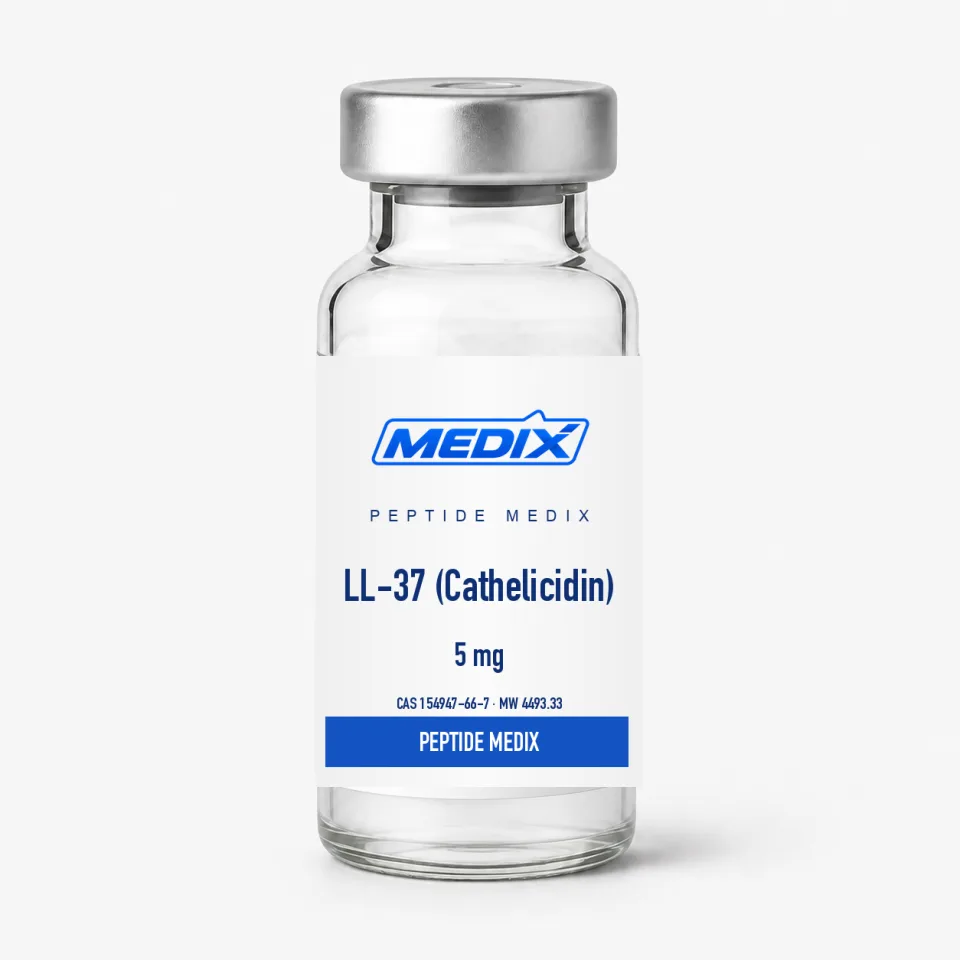
- HPLC purity ≥99%, with a COA for each lot on request
- Certificate of analysis tied to your lot number
- Tracked EU delivery, dispatched the next working day
LL-37 (Cathelicidin)
LL-37, the human cathelicidin — a 37-residue antimicrobial host-defence peptide
In stock2 formats availableCAS 154947-66-7
€97Range €97 – €165
This listing is currently unavailable. Contact us and we will tell you when it is back or suggest an equivalent.
Ask about this listing or request its COA- FormLyophilized powder, sealed glass vial with crimped stopper
- Mol. weight4493.33 g/mol
- Research areasAntimicrobial and antibiofilm assays, wound repair, immunomodulation, barrier immunity
For laboratory research use only. Sold exclusively for in-vitro laboratory research by qualified professionals. Not for human or veterinary use, and not a medicine, food, cosmetic or dietary supplement. Terms and Conditions
Overview
Key facts
LL-37 is the sole antimicrobial peptide of the cathelicidin family made by humans.
- CAS number
- 154947-66-7
- Molecular weight
- 4493.33 g/mol
- Amino acid sequence
- LLGDFFRKSKEKIGKEFKRIVQRIKDFLRNLVPRTES
- Purity
- ≥99% by HPLC; lot-matched COA available
- Form
- Lyophilized powder, sealed glass vial with crimped stopper
- Storage
- −20 °C, sealed and protected from light and moisture
- Available sizes
- 5 mg · 10 mg
For research use only. Not for human consumption.
LL-37 is the sole antimicrobial peptide of the cathelicidin family made by humans. Proteinase 3 cuts it from the C-terminal end of its precursor, hCAP18, and its name reflects its 37-residue length and the two leucines at its start. Neutrophils, epithelial cells and keratinocytes all produce it, and it operates where innate antimicrobial defence meets the control of inflammation.
Structurally, it forms a strongly positively charged, amphipathic alpha helix 37 residues long. This shape underpins the mechanism most often described: electrostatic attraction to negatively charged bacterial membranes, followed by breakdown of membrane integrity. The same amphipathic nature makes it a difficult peptide to synthesise and purify, which explains why it costs more than shorter sequences.
It comes as lyophilised powder in sealed vials of 5 mg or 10 mg; every lot is purified by reversed-phase HPLC to ≥99%, mass-confirmed and documented with its own certificate of analysis. Labs use it in antimicrobial and biofilm assays, wound models and immunomodulation research. Sold strictly for laboratory research.
What sets this listing apart
LL-37 (Cathelicidin) – vial, 5/10 mg. Lyophilized powder, sealed glass vial with crimped stopper. Other LL-37 listings differ in format, fill or combination partners; the specification and COA always refer to the listing you order.
Same compound, other listings
Specifications
Identity
- CAS number
- 154947-66-7
- Molecular weight
- 4493.33 g/mol
- Amino acid sequence
- LLGDFFRKSKEKIGKEFKRIVQRIKDFLRNLVPRTES
- Chain length
- 37 amino acids
- Peptide class
- Cathelicidin-family antimicrobial host-defence peptide
Supply & purity
- Form
- Lyophilized powder, sealed glass vial with crimped stopper
- Purity
- ≥99% by HPLC; lot-matched COA available
- Available sizes
- 5 mg, 10 mg
Handling & storage
- Storage (lyophilized)
- −20 °C, sealed and protected from light and moisture
- Storage (reconstituted)
- 2–8 °C, protected from light, used within the study window
Additional detail
- Precursor
- hCAP18; released by proteinase 3 cleavage of the C-terminal domain
- Structure
- Cationic amphipathic alpha helix with a strong net positive charge
- Research areas
- Antimicrobial and antibiofilm assays, wound repair, immunomodulation, barrier immunity
Questions about LL-37 (Cathelicidin)
What is LL-37?
The only cathelicidin antimicrobial peptide humans express — a cationic helix of 37 residues cleaved from the hCAP18 precursor. We supply it as a lyophilised research powder for antimicrobial, biofilm, wound-repair and immunomodulation studies.
Why does LL-37 cost more than shorter peptides?
Thirty-seven residues is a long chain to synthesise, and its amphipathic, strongly cationic nature makes both coupling and purification harder than for a short, water-loving sequence. Each synthesis run yields less, and that shows in the price per milligram.
What purity do you guarantee, and is there a COA?
Each lot is purified and analysed by reversed-phase HPLC to ≥99%, with mass spectrometry confirming the expected 4493.33 g/mol. The certificate bearing your vial's lot number can be requested before or after you order.
Does LL-37 require special handling?
It helps. The peptide clings to plastic and aggregates more easily than short hydrophilic peptides, so labs usually work with low-binding tubes, avoid the vortex mixer and make working dilutions fresh instead of keeping very dilute stocks for a long time.
In which research areas is it used?
Membrane-targeted antimicrobial assays against bacteria, fungi and enveloped viruses; biofilm disruption at sub-lethal levels; wound-repair models involving keratinocyte migration; and immunomodulation studies of lipopolysaccharide binding and dendritic-cell responses, including its suspected role in psoriasis.