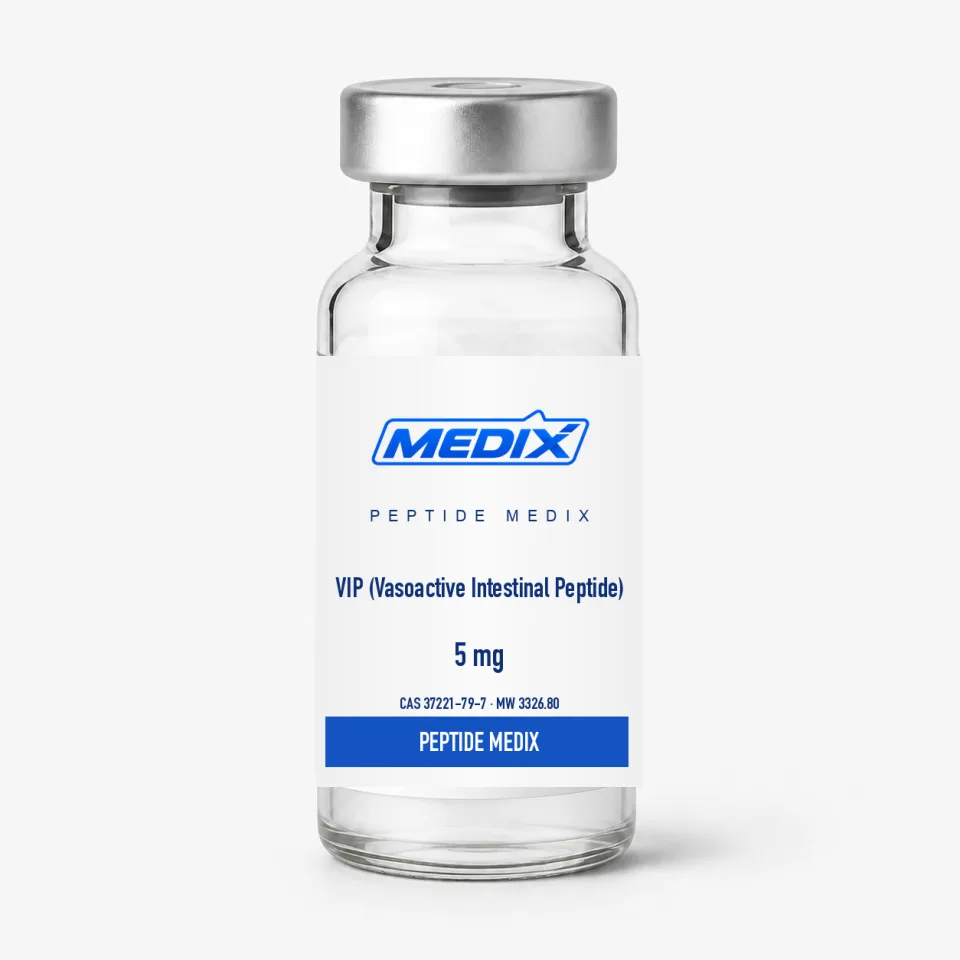
- HPLC purity ≥99%, with a COA for each lot on request
- Certificate of analysis tied to your lot number
- Tracked EU delivery, dispatched the next working day
VIP (Vasoactive Intestinal Peptide)
Vasoactive intestinal peptide — an amidated 28-residue neuropeptide
In stock2 formats availableCAS 37221-79-7
€97Range €97 – €170
This listing is currently unavailable. Contact us and we will tell you when it is back or suggest an equivalent.
Ask about this listing or request its COA- FormLyophilized powder, sealed glass vial with crimped stopper
- Mol. weight3326.80 g/mol
- Research areasVasodilation and smooth muscle, airway physiology, circadian biology, immune modulation
For laboratory research use only. Sold exclusively for in-vitro laboratory research by qualified professionals. Not for human or veterinary use, and not a medicine, food, cosmetic or dietary supplement. Terms and Conditions
Overview
Key facts
Vasoactive intestinal peptide (VIP) is a 28-amino-acid neuropeptide, first isolated from pig intestine and later found throughout the central and peripheral nervous systems, the gut, the lungs and immune tissue.
- CAS number
- 37221-79-7
- Molecular weight
- 3326.80 g/mol
- Amino acid sequence
- HSDAVFTDNYTRLRKQMAVKKYLNSILN-NH2
- Purity
- ≥99% by HPLC; lot-matched COA available
- Form
- Lyophilized powder, sealed glass vial with crimped stopper
- Storage
- −20 °C, sealed and protected from light and moisture
- Available sizes
- 5 mg · 10 mg
For research use only. Not for human consumption.
Vasoactive intestinal peptide (VIP) is a 28-amino-acid neuropeptide, first isolated from pig intestine and later found throughout the central and peripheral nervous systems, the gut, the lungs and immune tissue. A member of the secretin–glucagon superfamily, it shares structural traits with PACAP, secretin and glucagon, and its C-terminus is amidated — a modification needed for full receptor activation.
It signals mainly via two G protein-coupled receptors, VPAC1 and VPAC2, both of which increase intracellular cyclic AMP. The wide distribution of these receptors explains why VIP turns up in so many research fields — smooth-muscle relaxation and vasodilation, circadian control in the suprachiasmatic nucleus, lung and gut physiology, and immune-cell regulation all involve the same molecule.
Our VIP is made by solid-phase synthesis, purified by reversed-phase HPLC to ≥99% and filled as lyophilised powder into sealed 5 mg and 10 mg glass vials, each with its lot certificate. Its length and C-terminal amide make it a relatively demanding synthesis. For laboratory research only.
Specifications
Identity
- CAS number
- 37221-79-7
- Molecular weight
- 3326.80 g/mol
- Amino acid sequence
- HSDAVFTDNYTRLRKQMAVKKYLNSILN-NH2
- Chain length
- 28 amino acids, C-terminally amidated
- Peptide class
- Neuropeptide of the secretin-glucagon (VIP/PACAP) superfamily
Supply & purity
- Form
- Lyophilized powder, sealed glass vial with crimped stopper
- Purity
- ≥99% by HPLC; lot-matched COA available
- Available sizes
- 5 mg, 10 mg
Handling & storage
- Storage (lyophilized)
- −20 °C, sealed and protected from light and moisture
- Storage (reconstituted)
- 2–8 °C, protected from light, used within the study window
Additional detail
- Receptors
- VPAC1 and VPAC2 G protein-coupled receptors; signals via cyclic AMP
- Native distribution
- Central and enteric nervous systems, lung, gut, immune tissue
- Research areas
- Vasodilation and smooth muscle, airway physiology, circadian biology, immune modulation
Questions about VIP (Vasoactive Intestinal Peptide)
What is VIP?
Vasoactive intestinal peptide: a 28-residue neuropeptide from the secretin–glucagon superfamily. Originally isolated from intestine, it occurs throughout the nervous system, lungs, gut and immune tissue and acts via the VPAC1 and VPAC2 receptors.
Why does the sequence end in NH2?
Natural VIP carries a C-terminal amide, a post-translational modification that published pharmacology links to full receptor binding and activity. Research-grade synthetic VIP reproduces that amide instead of leaving a free carboxyl end.
Which receptors does VIP activate?
Mainly VPAC1 and VPAC2 — two closely related GPCRs that stimulate adenylate cyclase and raise intracellular cAMP. Since native VIP acts on both, much pharmacology relies on selective analogues to tease apart each subtype's contribution.
What purity do you supply, and is there a COA?
Each lot is purified and checked by reversed-phase HPLC to ≥99%, with its mass confirmed against the expected 3326.80 g/mol. The certificate carrying your vial's lot number can be requested before or after you buy.
How stable is VIP once reconstituted?
Less stable than short, rigid peptides: it is sensitive to peptidases and, like most longer amidated peptides, tends to aggregate and stick to surfaces. Labs usually aliquot straight after reconstitution, keep stocks cold and dark, and make working dilutions fresh each day.
Related