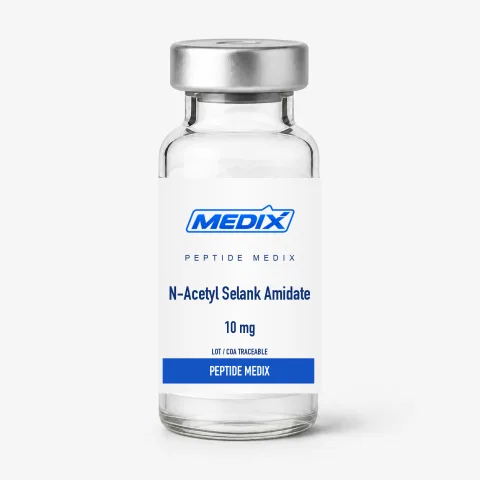
- HPLC purity ≥99%, with a COA for each lot on request
- Certificate of analysis tied to your lot number
- Tracked EU delivery, dispatched the next working day
Selank
Heptapeptide derived from tuftsin, for research on anxiolytic and immune signalling
In stock2 formats availableCAS 129954-34-3
€42Range €42 – €68
This listing is currently unavailable. Contact us and we will tell you when it is back or suggest an equivalent.
Ask about this listing or request its COA- FormLyophilized white powder in a sealed glass vial
- Mol. weight751.89 g/mol
- Research areasAnxiety-like behavior, GABAergic and monoaminergic signaling, cytokine expression, BDNF
For laboratory research use only. Sold exclusively for in-vitro laboratory research by qualified professionals. Not for human or veterinary use, and not a medicine, food, cosmetic or dietary supplement. Terms and Conditions
Overview
Key facts
Selank starts from tuftsin — Thr-Lys-Pro-Arg, an immunomodulatory tetrapeptide located in the Fc portion of immunoglobulin G — and extends it into a synthetic heptapeptide.
- CAS number
- 129954-34-3
- Molecular formula
- C33H57N11O9
- Molecular weight
- 751.89 g/mol
- Amino acid sequence
- Thr-Lys-Pro-Arg-Pro-Gly-Pro
- Purity
- ≥99% by HPLC; lot-matched COA available
- Form
- Lyophilized white powder in a sealed glass vial
- Storage
- −20 °C, protected from light and moisture
- Available sizes
- 5 mg · 10 mg
For research use only. Not for human consumption.
Selank starts from tuftsin — Thr-Lys-Pro-Arg, an immunomodulatory tetrapeptide located in the Fc portion of immunoglobulin G — and extends it into a synthetic heptapeptide. As in Semax, a C-terminal Pro-Gly-Pro tail is added to hold off peptidases, giving the sequence Thr-Lys-Pro-Arg-Pro-Gly-Pro and a molecular weight of 751.89 g/mol.
We supply Selank as lyophilised powder in vials of 5 mg or 10 mg for in vitro assays, analytical work and authorised animal-model research. Every lot is HPLC-verified, comes with its own certificate of analysis and is dispatched from our EU warehouse.
What sets this listing apart
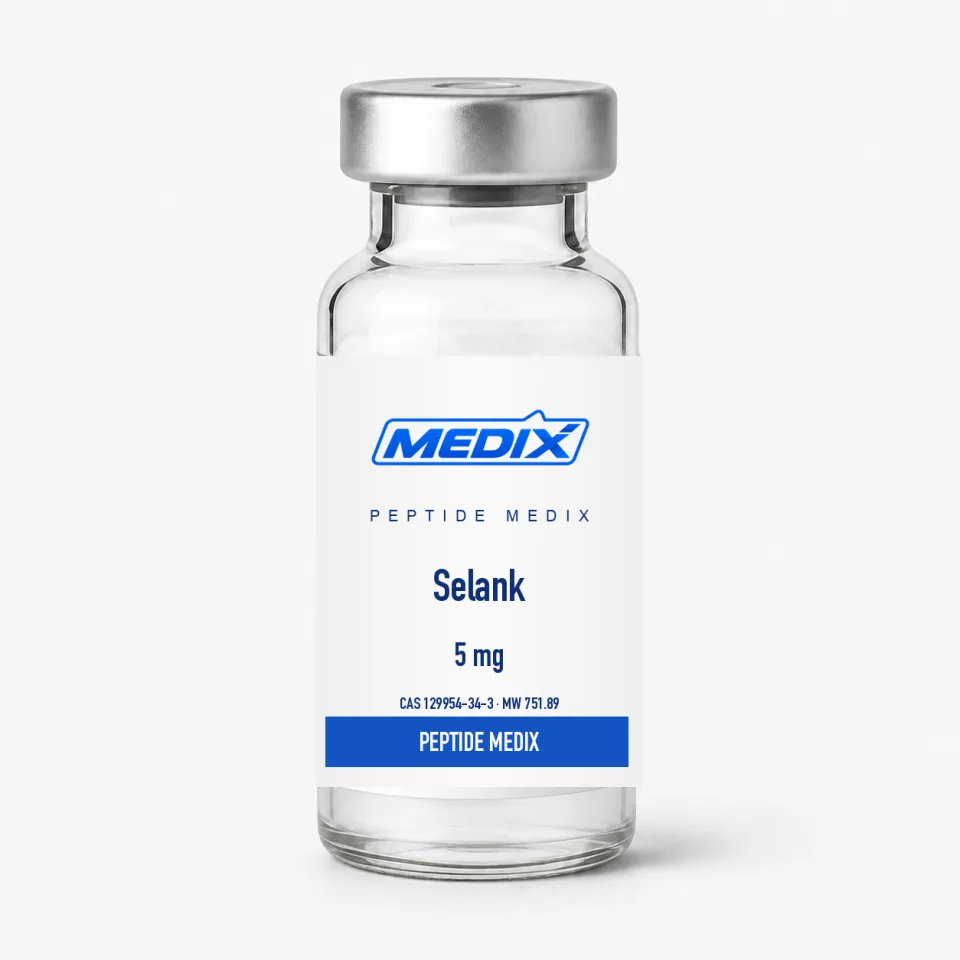
Selank – vial, 5/10 mg. Lyophilized white powder in a sealed glass vial. Other Selank listings differ in format, fill or combination partners; the specification and COA always refer to the listing you order.
Same compound, other listings
Specifications
Identity
- CAS number
- 129954-34-3
- Molecular formula
- C33H57N11O9
- Molecular weight
- 751.89 g/mol
- Amino acid sequence
- Thr-Lys-Pro-Arg-Pro-Gly-Pro
- Peptide class
- Synthetic tuftsin analog / regulatory neuropeptide
Supply & purity
- Form
- Lyophilized white powder in a sealed glass vial
- Purity
- ≥99% by HPLC; lot-matched COA available
- Available sizes
- 5 mg, 10 mg
- Solubility
- Freely soluble in bacteriostatic water and sterile water
Handling & storage
- Storage (lyophilized)
- −20 °C, protected from light and moisture
- Storage (reconstituted)
- 2–8 °C; avoid repeated freeze-thaw cycles
Additional detail
- Parent molecule
- Tuftsin (Thr-Lys-Pro-Arg), an IgG-derived immunopeptide
- Research areas
- Anxiety-like behavior, GABAergic and monoaminergic signaling, cytokine expression, BDNF
Questions about Selank
What purity testing does Selank undergo?
Reversed-phase HPLC establishes purity and mass spectrometry confirms identity for each lot. On request you receive the certificate for the batch actually shipped to you, stating purity, observed molecular mass and test date.
Which vial sizes can I choose?
Two: 5 mg and 10 mg of lyophilised powder. The larger vial lets a longer series run on a single lot number, making analytical comparisons across runs simpler.
Does Selank stay stable once dissolved?
The lyophilised powder at −20 °C is the stable form. Once in water, peptides of this type are best refrigerated at 2–8 °C away from light and used within the planned study period; avoid freezing and thawing them repeatedly.
Which solvent should I use?
Selank dissolves freely in water. For bench reconstitution, bacteriostatic water is the norm; choose sterile water when the solution must be preservative-free. Your assay protocol determines the working concentration.
Related