- HPLC purity ≥99%, with a COA for each lot on request
- Certificate of analysis tied to your lot number
- Tracked EU delivery, dispatched the next working day
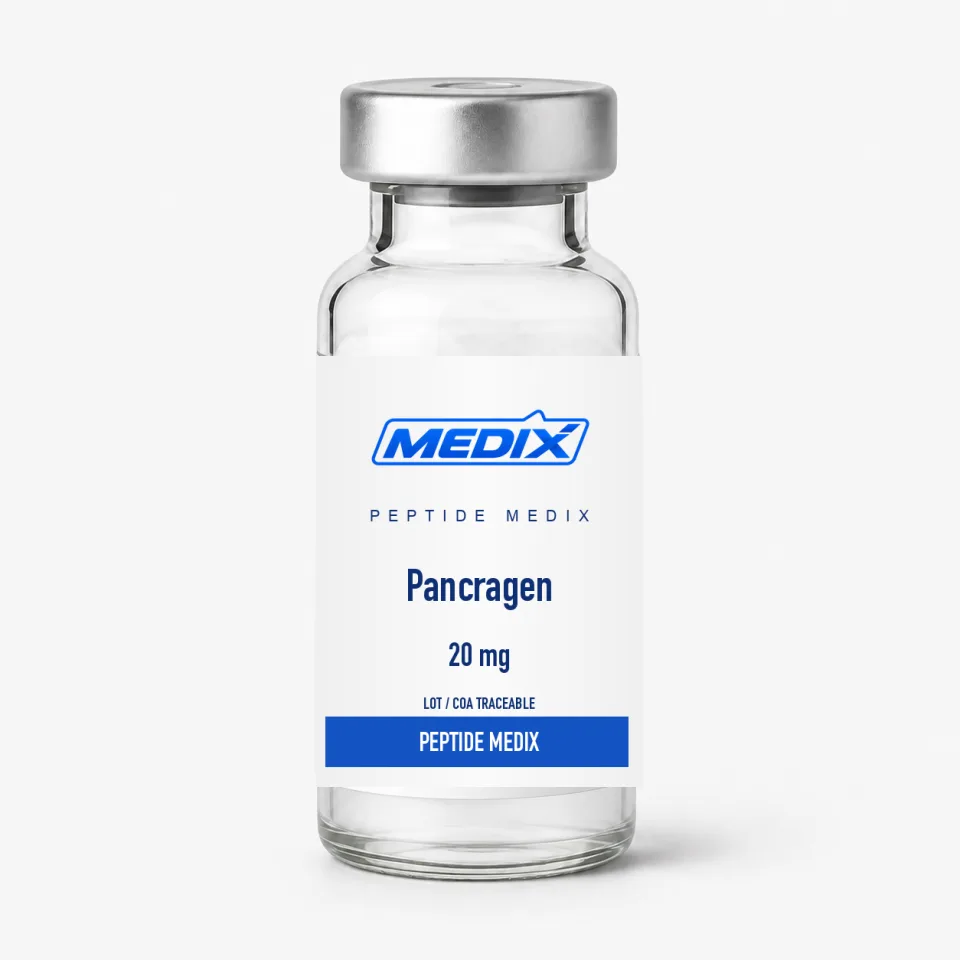
Pancragen
KEDW (Lys-Glu-Asp-Trp) short-peptide bioregulator in a 20 mg vial
In stock1 format available
€63
This listing is currently unavailable. Contact us and we will tell you when it is back or suggest an equivalent.
Ask about this listing or request its COA- FormLyophilized powder in a sealed glass vial
- Mol. weight≈576.6 g/mol
- Research areasIslet and beta-cell cultures, Pdx1 and Ngn3 expression, insulin gene expression, cell proliferation and apoptosis in ageing models
For laboratory research use only. Sold exclusively for in-vitro laboratory research by qualified professionals. Not for human or veterinary use, and not a medicine, food, cosmetic or dietary supplement. Terms and Conditions
Overview
Key facts
Pancragen is the four-residue peptide Lys-Glu-Asp-Trp — KEDW for short — one of the synthetic bioregulators created in Vladimir Khavinson's programme at the Saint Petersburg Institute of Bioregulation and Gerontology.
- Molecular formula
- C26H36N6O9
- Molecular weight
- ≈576.6 g/mol
- Amino acid sequence
- Lys-Glu-Asp-Trp (KEDW)
- Purity
- ≥99% by HPLC; lot-matched COA available
- Form
- Lyophilized powder in a sealed glass vial
- Storage
- −20 °C, sealed and protected from light and moisture
- Available size
- 20 mg
For research use only. Not for human consumption.
Pancragen is the four-residue peptide Lys-Glu-Asp-Trp — KEDW for short — one of the synthetic bioregulators created in Vladimir Khavinson's programme at the Saint Petersburg Institute of Bioregulation and Gerontology. That programme ties each short sequence to a particular tissue, and Pancragen is the one assigned to the pancreas, serving as the synthetic successor to the older organ-extract product Suprefort.
It comes as a lyophilised 20 mg vial of peptide with ≥99% HPLC purity and a certificate of analysis for the lot. With just four residues and a mass of about 577 g/mol, KEDW is small enough to make the family's proposed mechanism at least structurally conceivable: rather than binding a surface receptor, these peptides are suggested to enter cells and nuclei and interact with particular DNA sequences to adjust transcription. Modelling and cell studies from the originating group support this, but independent replication elsewhere remains scarce.
Specifications
Identity
- Molecular formula
- C26H36N6O9
- Molecular weight
- ≈576.6 g/mol
- Amino acid sequence
- Lys-Glu-Asp-Trp (KEDW)
- Chain length
- 4 amino acids (tetrapeptide)
- Peptide class
- Khavinson short-peptide bioregulator (tetrapeptide)
Supply & purity
- Form
- Lyophilized powder in a sealed glass vial
- Purity
- ≥99% by HPLC; lot-matched COA available
- Solubility
- Bacteriostatic or sterile water; readily soluble in aqueous buffers
Handling & storage
- Storage (lyophilized)
- −20 °C, sealed and protected from light and moisture
- Storage (reconstituted)
- 2–8 °C, protected from light; use within the study window
Additional detail
- Available size
- 20 mg
- Tissue association
- Pancreatic peptide preparations; synthetic analogue of Suprefort
- Proposed mechanism studied
- Direct peptide–DNA and chromatin interaction influencing transcription, rather than surface-receptor signalling
- Research areas
- Islet and beta-cell cultures, Pdx1 and Ngn3 expression, insulin gene expression, cell proliferation and apoptosis in ageing models
Questions about Pancragen
What does the abbreviation KEDW mean?
It is the one-letter code for the sequence: K lysine, E glutamic acid, D aspartic acid, W tryptophan. In the Khavinson literature, this synthetic tetrapeptide is called Pancragen and is linked to pancreatic tissue preparations.
What is the connection between Pancragen and Suprefort?
Suprefort is the earlier product, an extract of animal pancreatic tissue containing a peptide mixture. Pancragen is the defined synthetic tetrapeptide intended to reproduce that activity with a single known sequence — far easier to work with in research.
Which purity data and documents do you provide?
Vials are ≥99% pure by HPLC, and each lot comes with its own certificate showing purity and identity confirmed by mass spectrometry. Please quote the lot number on the vial label when requesting it.
How robust is the evidence so far?
Early-stage. Most studies come from the group that proposed the short-peptide bioregulator concept and involve cell cultures and small animals rather than independent trials. Include sequence-specific controls, since specificity is precisely the claim under test.
What are the storage conditions?
Keep the lyophilised powder sealed at −20 °C, dry and away from light. After reconstitution, store at 2–8 °C protected from light and use within your defined study period, or aliquot and freeze to avoid repeated freeze–thaw cycles that damage the peptide.