- HPLC purity ≥99%, with a COA for each lot on request
- Certificate of analysis tied to your lot number
- Tracked EU delivery, dispatched the next working day
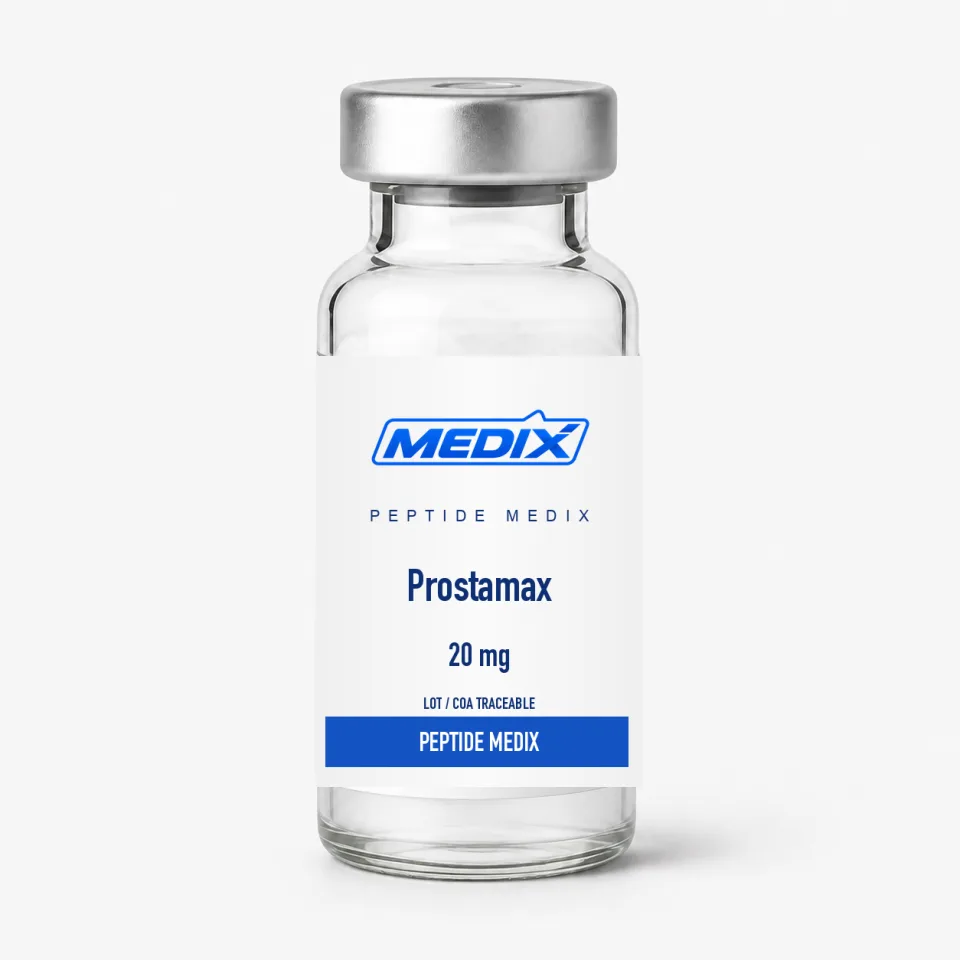
Prostamax
KEDP (Lys-Glu-Asp-Pro) tetrapeptide for research in prostate-tissue models
In stock1 format available
€63
This listing is currently unavailable. Contact us and we will tell you when it is back or suggest an equivalent.
Ask about this listing or request its COA- FormLyophilized powder in a sealed glass vial
- Mol. weight487.51 g/mol
- Research areasProstate tissue models, epithelial cell culture, gene expression, tissue ageing
For laboratory research use only. Sold exclusively for in-vitro laboratory research by qualified professionals. Not for human or veterinary use, and not a medicine, food, cosmetic or dietary supplement. Terms and Conditions
Overview
Key facts
Prostamax is the synthetic tetrapeptide L-lysyl-L-glutamyl-L-aspartyl-L-proline — Lys-Glu-Asp-Pro, KEDP.
- Molecular formula
- C20H33N5O9
- Molecular weight
- 487.51 g/mol
- Amino acid sequence
- Lys-Glu-Asp-Pro (KEDP), linear tetrapeptide
- Purity
- ≥99% by HPLC; lot-matched COA available
- Form
- Lyophilized powder in a sealed glass vial
- Storage
- −20 °C, sealed and protected from light and moisture
- Available size
- 20 mg
For research use only. Not for human consumption.
Prostamax is the synthetic tetrapeptide L-lysyl-L-glutamyl-L-aspartyl-L-proline — Lys-Glu-Asp-Pro, KEDP. In the Khavinson short-peptide bioregulator series, it is the sequence connected with prostate tissue preparations. The same name is also used commercially for prostate peptide complexes made from tissue extracts; what we supply is the defined synthetic tetrapeptide, characterised by its sequence, formula and molecular weight rather than by an extract's composition.
Published laboratory work focuses on prostate tissue in rodents, epithelial cell cultures and head-to-head comparisons with other members of the family. We supply Prostamax as a 20 mg lyophilised vial produced by SPPS and HPLC-purified to a ≥99% specification, with a certificate of analysis for the lot. Laboratory research only.
Specifications
Identity
- Molecular formula
- C20H33N5O9
- Molecular weight
- 487.51 g/mol
- Amino acid sequence
- Lys-Glu-Asp-Pro (KEDP), linear tetrapeptide
- Peptide class
- Khavinson short-peptide bioregulator (tetrapeptide)
Supply & purity
- Form
- Lyophilized powder in a sealed glass vial
- Purity
- ≥99% by HPLC; lot-matched COA available
- Available sizes
- 20 mg
- Solubility
- Bacteriostatic or sterile water; readily soluble in aqueous buffers
Handling & storage
- Storage (lyophilized)
- −20 °C, sealed and protected from light and moisture
- Storage (reconstituted)
- 2–8 °C, protected from light; use within the study window
Additional detail
- Tissue association
- Prostate peptide preparations
- Research areas
- Prostate tissue models, epithelial cell culture, gene expression, tissue ageing
- Structural note
- C-terminal proline restricts backbone rotation relative to KEDG and KEDA
Questions about Prostamax
What exactly is Prostamax?
The synthetic tetrapeptide KEDP (Lys-Glu-Asp-Pro), part of Khavinson's short bioregulator series and linked there to prostate tissue. It is sold as a lyophilised research chemical for lab use only.
Single peptide or peptide complex?
This product is the single, defined synthetic tetrapeptide KEDP, identified by sequence, formula and weight. Some vendors apply the Prostamax name to prostate peptide complexes extracted from tissue — an entirely different type of material.
How do you check its purity?
HPLC analysis against a ≥99% purity specification for every lot. The certificate, available on request, lists the batch code, the purity measured, identity confirmation and physical appearance.
What does the proline contribute?
Proline's side chain loops back to the backbone nitrogen, limiting rotation and locking a bend into the chain. In a peptide of only four residues that restricts the shapes it can take, making KEDP a useful conformational comparator to KEDG and KEDA.
How should Prostamax be stored?
Keep sealed vials at −20 °C, protected from light and moisture. Reconstituted solution can be held at 2–8 °C through the planned study, or aliquoted and frozen to avoid thawing it more than once.