- HPLC purity ≥99%, with a COA for each lot on request
- Certificate of analysis tied to your lot number
- Tracked EU delivery, dispatched the next working day
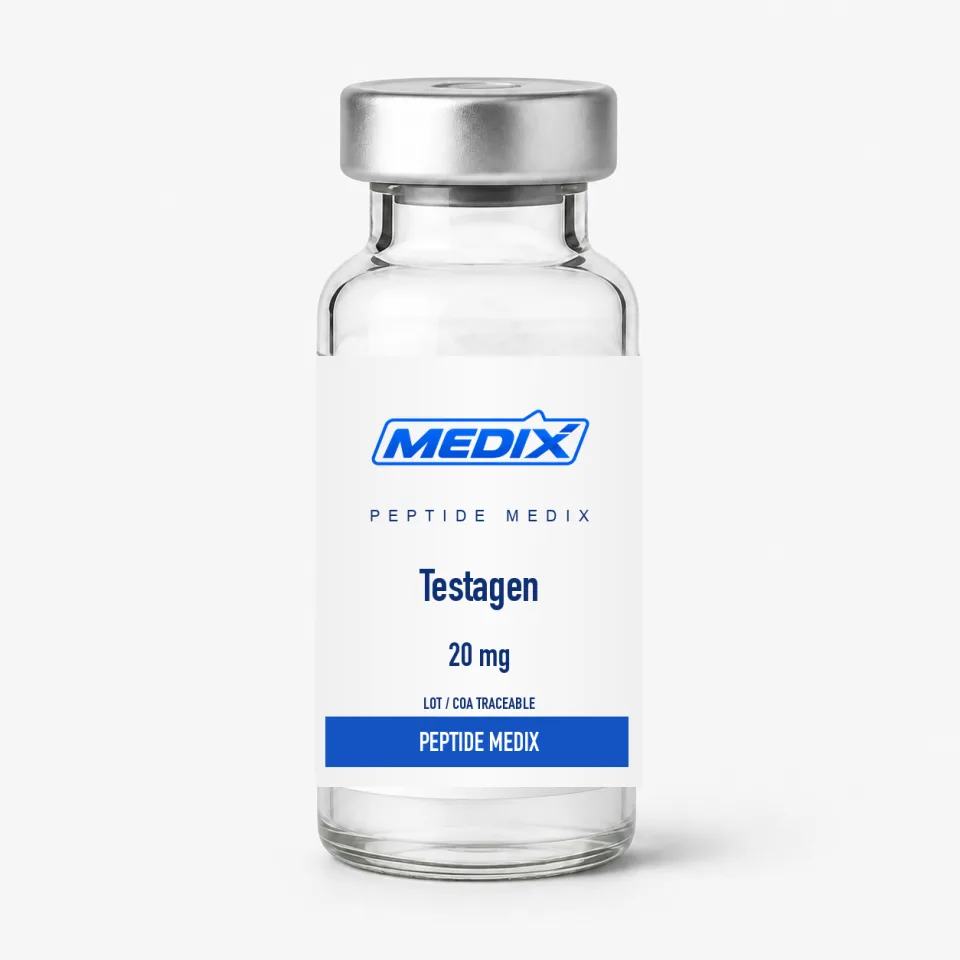
Testagen
KEDG (Lys-Glu-Asp-Gly) tetrapeptide for reproductive-tissue research models
In stock1 format available
€63
This listing is currently unavailable. Contact us and we will tell you when it is back or suggest an equivalent.
Ask about this listing or request its COA- FormLyophilized powder in a sealed glass vial
- Mol. weight447.44 g/mol
- Research areasReproductive tissue models, germ-cell and steroidogenic markers, gene expression, ageing
For laboratory research use only. Sold exclusively for in-vitro laboratory research by qualified professionals. Not for human or veterinary use, and not a medicine, food, cosmetic or dietary supplement. Terms and Conditions
Overview
Key facts
Testagen is L-lysyl-L-glutamyl-L-aspartyl-glycine — Lys-Glu-Asp-Gly, abbreviated KEDG — made synthetically and supplied as H-Lys-Glu-Asp-Gly-OH with unmodified ends.
- Molecular formula
- C17H29N5O9
- Molecular weight
- 447.44 g/mol
- Amino acid sequence
- H-Lys-Glu-Asp-Gly-OH (KEDG)
- Purity
- ≥99% by HPLC; lot-matched COA available
- Form
- Lyophilized powder in a sealed glass vial
- Storage
- −20 °C, sealed and protected from light and moisture
- Available size
- 20 mg
For research use only. Not for human consumption.
Testagen is L-lysyl-L-glutamyl-L-aspartyl-glycine — Lys-Glu-Asp-Gly, abbreviated KEDG — made synthetically and supplied as H-Lys-Glu-Asp-Gly-OH with unmodified ends. Among the Khavinson short-peptide bioregulators it is the sequence tied to gonadal and reproductive tissue preparations. The design follows the family pattern: begin with a peptide extract from tissue, find a short active sequence within it, then synthesise that sequence so experiments run on one defined molecule.
KEDG is Vesugen (KED) lengthened by a single C-terminal glycine. That makes the pair handy at the bench: researchers can check whether a small, flexible extra residue alters reported selectivity or activity while nothing else changes. Glycine, having no side chain, is the gentlest possible addition — part of what makes the comparison meaningful.
Studies with KEDG have focused on testicular and gonadal tissue in rodents, cell cultures measuring steroidogenic and germ-cell markers, and head-to-head assays with other peptides from the series. Our Testagen comes as a 20 mg lyophilised vial, HPLC-purified against a ≥99% specification with its lot certificate, for laboratory research only.
Specifications
Identity
- Molecular formula
- C17H29N5O9
- Molecular weight
- 447.44 g/mol
- Amino acid sequence
- H-Lys-Glu-Asp-Gly-OH (KEDG)
- Peptide class
- Khavinson short-peptide bioregulator (tetrapeptide)
Supply & purity
- Form
- Lyophilized powder in a sealed glass vial
- Purity
- ≥99% by HPLC; lot-matched COA available
- Available sizes
- 20 mg
- Solubility
- Bacteriostatic or sterile water; readily soluble in aqueous buffers
Handling & storage
- Storage (lyophilized)
- −20 °C, sealed and protected from light and moisture
- Storage (reconstituted)
- 2–8 °C, protected from light; use within the study window
Additional detail
- Tissue association
- Testicular and gonadal peptide preparations
- Research areas
- Reproductive tissue models, germ-cell and steroidogenic markers, gene expression, ageing
- Sequence relationship
- Vesugen (KED) plus a C-terminal glycine residue
Questions about Testagen
What kind of peptide is Testagen?
KEDG, a synthetic Lys-Glu-Asp-Gly tetrapeptide belonging to Khavinson's bioregulator family and linked in those papers to gonadal tissue. We sell it as lyophilised research material, for lab use only.
Will I receive a certificate of analysis?
Yes — on request. Every lot is checked by HPLC against the ≥99% specification, and its COA records batch code, measured purity, identity and appearance.
Why is the CAS field left blank?
We know of no broadly recognised CAS entry for KEDG, so publishing a number we can't verify would be wrong. Sequence, formula and weight are given instead, each confirmed on the lot COA.
What is the link with Vesugen?
Add one glycine to the end of Vesugen's KED and you get Testagen. As glycine carries no side chain, the two are frequently used together to see whether merely extending the chain affects what an assay reports.
What storage does it need?
Sealed vials belong at −20 °C, shielded from light and damp. After dissolving, the solution can stay at 2–8 °C for the duration of the study, or be split into single-use portions and frozen so none is thawed twice.
Related