- HPLC-assayed purity of ≥99%
- Certificate of analysis tied to your lot number
- Tracked EU delivery, dispatched the next working day
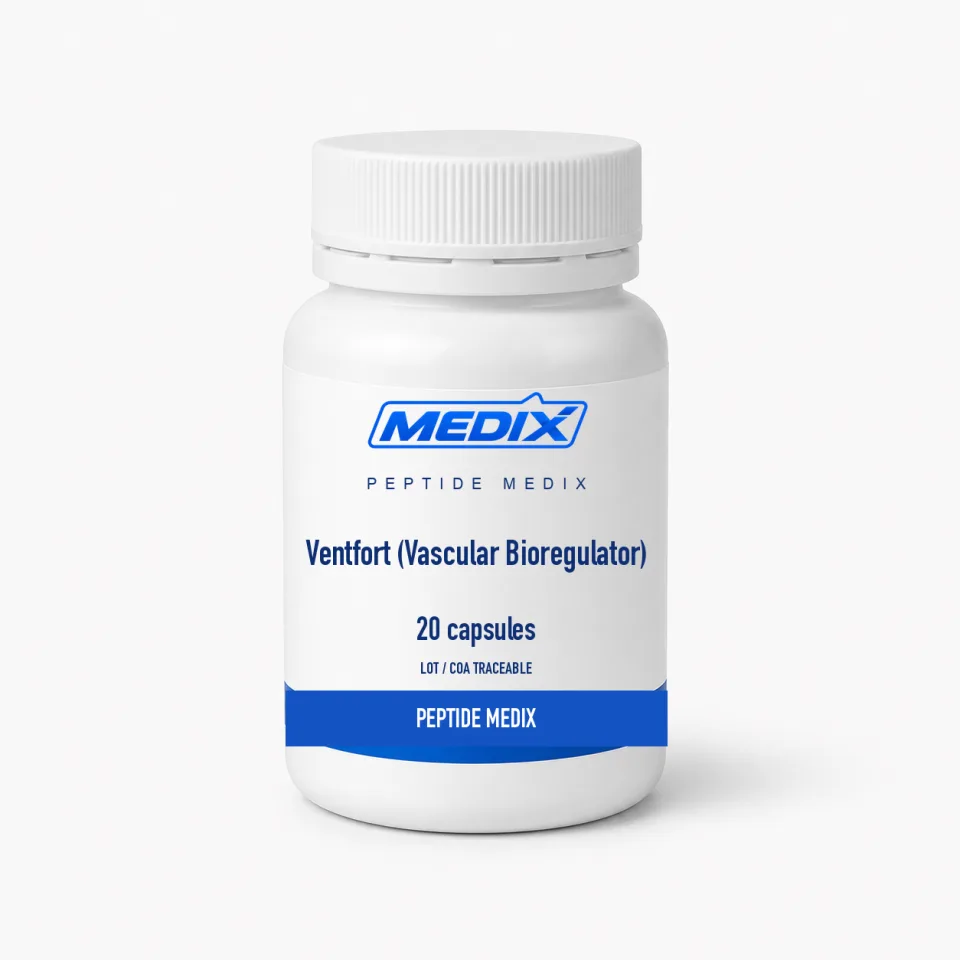
Ventfort (Vascular Bioregulator)
Peptide complex from blood-vessel tissue in capsules — Khavinson Cytomax series
In stock2 formats available
€72Range €72 – €182
This listing is currently unavailable. Contact us and we will tell you when it is back or suggest an equivalent.
Ask about this listing or request its COA- FormOral research capsules in a sealed bottle with tamper-evident closure
- Research areasEndothelial cell models, vessel-wall structure, vascular ageing, gene and protein expression endpoints
For laboratory research use only. Sold exclusively for in-vitro laboratory research by qualified professionals. Not for human or veterinary use, and not a medicine, food, cosmetic or dietary supplement. Terms and Conditions
Overview
Key facts
Ventfort is the blood-vessel member of the natural bioregulator series that Vladimir Khavinson's team developed at their St Petersburg gerontology institute.
- Form
- Oral research capsules in a sealed bottle with tamper-evident closure
- Storage
- Room temperature, dry, sealed and protected from light
- Available sizes
- 20 capsules · 60 capsules
For research use only. Not for human consumption.
Ventfort is the blood-vessel member of the natural bioregulator series that Vladimir Khavinson's team developed at their St Petersburg gerontology institute. In contrast to the programme's synthetic short peptides, it comes from tissue: vessel walls from young animals are fractionated to obtain a complex of small peptides, which is purified and filled into capsules. What you get, therefore, is a mixture identified by its fraction profile — there is no single sequence with a formula and molecular weight.
Knowing how the series is built helps when planning experiments. Every organ product in it — for blood vessels, heart, pineal gland, thymus and more — began life as an extract, and for some organs a specific short peptide was later pinned down and synthesised as a research substitute. For vascular tissue, Ventfort is the extract and Vesugen (Lys-Glu-Asp) is the matching defined tripeptide. Setting the two against each other is one of the study designs used most often in this field.
Specifications
Supply & purity
- Form
- Oral research capsules in a sealed bottle with tamper-evident closure
Additional detail
- Available counts
- 20 capsules, 60 capsules
- Product type
- Tissue-derived peptide complex (mixture), not a single-sequence peptide
- Source material
- Vessel-wall tissue of young animals, fractionated and purified
- Composition
- Water-soluble low-molecular-weight peptide fractions with associated amino acids
- Molecular weight range
- Peptide fractions typically below approximately 10 kDa
- Series
- Khavinson natural peptide bioregulators (cytomax line)
- Tissue association
- Vascular endothelium and vessel wall
- Synthetic counterpart
- Vesugen (Lys-Glu-Asp, KED) — the defined tripeptide assigned to vascular tissue
- Research areas
- Endothelial cell models, vessel-wall structure, vascular ageing, gene and protein expression endpoints
- Analytical documentation
- Identity and fraction-profile testing per lot; documentation available on request
- Storage
- Room temperature, dry, sealed and protected from light
Questions about Ventfort (Vascular Bioregulator)
What is Ventfort?
The blood-vessel product in Khavinson's range of bioregulators obtained from tissue. It is a complex of small peptides separated from vessel walls, supplied here in research capsules — a mixture described by its fraction profile, not one peptide with a known sequence.
What distinguishes Ventfort from Vesugen?
Ventfort is an extract of tissue, whereas Vesugen is Lys-Glu-Asp, the synthetic tripeptide the same programme assigns to blood vessels. Vesugen can be specified to ≥99% purity and has a formula and molecular mass; Ventfort is characterised by its fraction profile. Many labs test both together.
Why aren't a sequence and molecular weight given?
Because it contains a whole set of peptide fractions, not a single compound. Its analytical records give identity markers and how the small fractions — mostly below roughly 10 kDa — are distributed. Assigning one formula or sequence to such a product would misrepresent it.
Which documents accompany a lot?
Each lot is backed by records of identity testing and of its fraction profile, which you can ask for before or after placing an order. Batches of a tissue extract differ from each other more than batches of a synthetic peptide do, so note the lot number next to your results.
How is it prepared for lab use?
For in vitro work, disperse the capsule contents in water or a physiological buffer, then centrifuge or filter to remove insoluble excipients before adding the soluble fraction to your assay. Prepare working solutions fresh and note the preparation method in the protocol.
How solid is the evidence for the bioregulator series?
The original research comes mostly from a handful of labs in Russia, is largely published in Russian, relies on small groups and has seldom been repeated independently. The mechanism put forward — short peptides adjusting gene expression in their own tissue — is still a hypothesis being tested, not an established fact.