- HPLC-assayed purity of ≥99%
- Certificate of analysis tied to your lot number
- Tracked EU delivery, dispatched the next working day
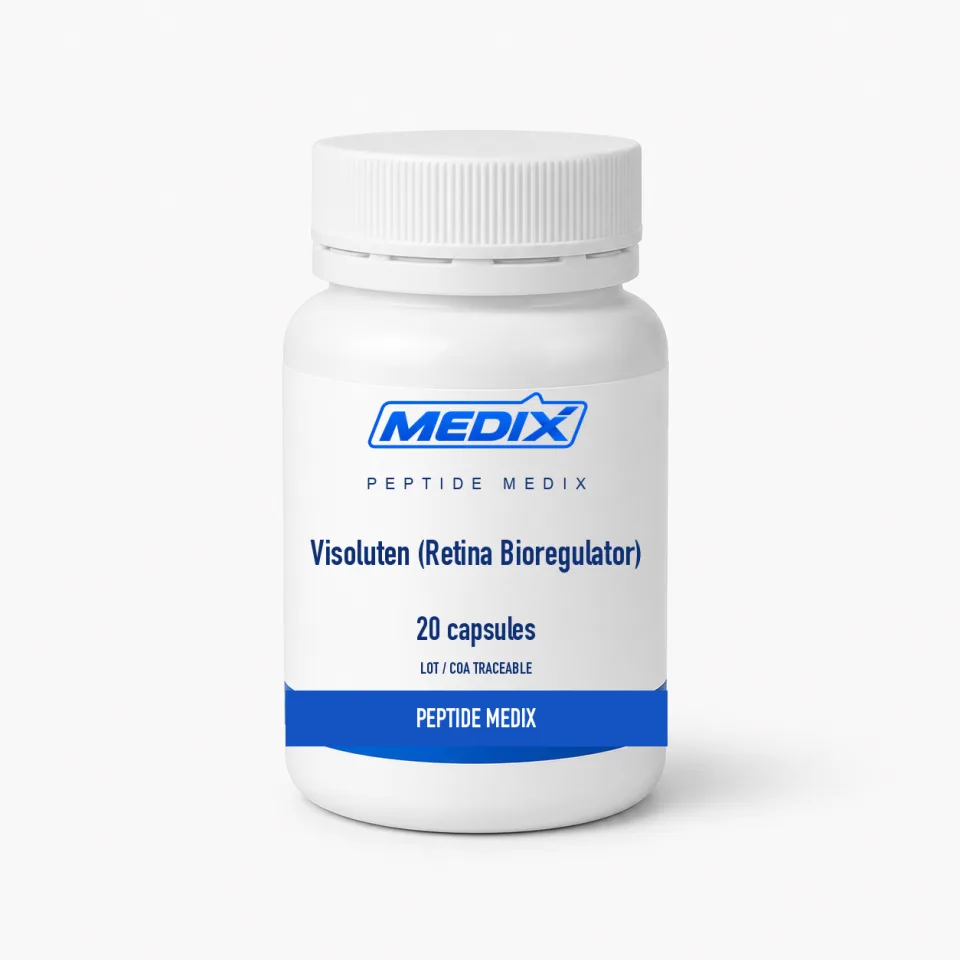
Visoluten (Retina Bioregulator)
Peptide complex derived from retina, in capsules — Cytomax bioregulator range
In stock2 formats available
€72Range €72 – €182
This listing is currently unavailable. Contact us and we will tell you when it is back or suggest an equivalent.
Ask about this listing or request its COA- FormCapsules containing a lyophilized peptide complex with excipient carrier
- Mol. weightPolydisperse low-molecular-weight fraction; no single molecular mass applies
- Research areasRetinal ageing models, photoreceptor and pigment epithelium biology, tissue-derived peptide complexes, comparative bioregulator studies
For laboratory research use only. Sold exclusively for in-vitro laboratory research by qualified professionals. Not for human or veterinary use, and not a medicine, food, cosmetic or dietary supplement. Terms and Conditions
Overview
Key facts
Among the natural bioregulators from the Russian gerontology programme associated with Vladimir Khavinson, Visoluten is the one tied to the retina.
- Molecular weight
- Polydisperse low-molecular-weight fraction; no single molecular mass applies
- Form
- Capsules containing a lyophilized peptide complex with excipient carrier
- Storage
- 2–8 °C or cool room temperature in the sealed original container, protected from light, heat and humidity
- Available sizes
- 20 capsules · 60 capsules
For research use only. Not for human consumption.
Among the natural bioregulators from the Russian gerontology programme associated with Vladimir Khavinson, Visoluten is the one tied to the retina. It is unlike the family's synthetic tripeptides — Pinealon, Cartalax, Vesugen and others — in that it has no single, defined sequence. Instead, bovine retina is extracted and fractionated under controlled conditions to yield a complex of small peptides, which is then put into capsules.
That difference shapes how the product is used. A synthetic tripeptide is pinned down by its sequence, formula and HPLC purity; a complex taken from tissue is described instead by the tissue it came from, how it was extracted, how much peptide it contains in total and its upper molecular-weight limit — usually a few kilodaltons at most. Researchers in the bioregulator field work with such complexes on the premise that a blend of short peptides from one tissue carries information relevant to that tissue — the idea the programme started from, with organ extracts coming first and single synthetic sequences only later.
Specifications
Identity
- Molecular weight
- Polydisperse low-molecular-weight fraction; no single molecular mass applies
Supply & purity
- Form
- Capsules containing a lyophilized peptide complex with excipient carrier
- Available sizes
- 20 capsules, 60 capsules
Additional detail
- Product type
- Natural peptide bioregulator (tissue-derived peptide complex)
- Source tissue
- Bovine retinal tissue
- Preparation
- Controlled extraction and fractionation to a low-molecular-weight peptide fraction
- Composition
- Peptide complex of undefined individual sequences; specified by total peptide content, not by a single formula
- Also known as
- Retina peptide bioregulator, Cytomax retina complex
- Bioregulator branch
- Natural extract range (Cytomax), as distinct from the synthetic peptide range (Cytogen)
- Associated tissue
- Retina and visual neural tissue
- Research areas
- Retinal ageing models, photoreceptor and pigment epithelium biology, tissue-derived peptide complexes, comparative bioregulator studies
- Storage
- 2–8 °C or cool room temperature in the sealed original container, protected from light, heat and humidity
- Documentation
- Lot documentation available on request
Questions about Visoluten (Retina Bioregulator)
Why isn't an amino-acid sequence given?
Visoluten isn't a single peptide. It is a fraction of small peptides extracted from retinal tissue, and the sequences of its individual components aren't specified. The synthetic members of the family — Pinealon or Cartalax, for example — are the ones with defined sequences.
How do natural and synthetic bioregulators differ?
Natural bioregulators such as Visoluten are extracts of tissue, fractionated down to small peptides. Synthetic ones are single, chemically defined sequences made by solid-phase synthesis. The synthetic kind is reproducible and lets you attribute an effect to one molecule; the natural kind keeps any effect the mixture as a whole may have.
Which documents accompany it?
Lot documents can be requested. For a complex derived from tissue, they give the source tissue, how much peptide the product contains and how molecular weights are distributed, rather than the HPLC purity we quote for synthetic peptides — for a mixture, one purity figure wouldn't mean much.
How do I store Visoluten?
Leave it in its closed original container, protected from light, warmth and moisture — either in the fridge (2–8 °C) or in a cool, dry cupboard. Peptide complexes attract water, so don't transfer them to other containers, and close the pack after every use.
Is it connected to any eye medicine?
No. It has no authorised indication in the EU, the United States or any other market we serve, is not an ophthalmic product and is neither sterile nor formulated for contact with the eye. It is simply research material derived from retinal tissue.
How robust is the published evidence?
It is limited. Most studies of tissue-derived bioregulators come from a few institutions and appear mainly in regional journals, and independent replication is rare. Outside those groups, claims that the effects are tissue-specific remain unproven, so design studies with control extracts from other tissues.