- HPLC purity ≥98%, with a COA for each lot on request
- Certificate of analysis tied to your lot number
- Tracked EU delivery, dispatched the next working day
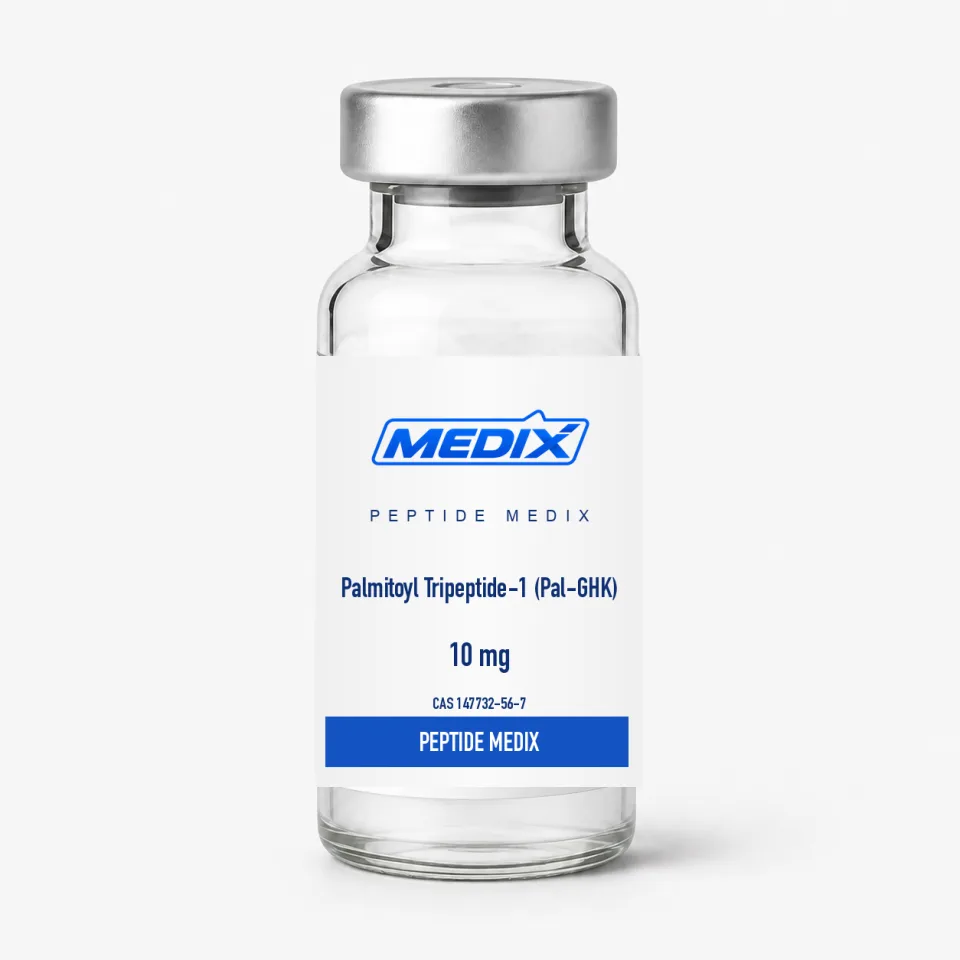
Palmitoyl Tripeptide-1 (Pal-GHK)
Palmitoylated Gly-His-Lys matrikine researched in collagen and ECM models
In stock2 formats availableCAS 147732-56-7
€46Range €46 – €131
This listing is currently unavailable. Contact us and we will tell you when it is back or suggest an equivalent.
Ask about this listing or request its COA- FormLyophilized powder, sealed glass vial
- Mol. weight578.8 g/mol
- Research areasCollagen and glycosaminoglycan synthesis, ECM remodelling, fibroblast signalling, transdermal penetration of lipidated peptides
For laboratory research use only. Sold exclusively for in-vitro laboratory research by qualified professionals. Not for human or veterinary use, and not a medicine, food, cosmetic or dietary supplement. Terms and Conditions
Overview
Key facts
Palmitoyl tripeptide-1 is Gly-His-Lys carrying a 16-carbon palmitic acid chain on its N-terminal glycine.
- CAS number
- 147732-56-7
- Molecular formula
- C30H54N6O5
- Molecular weight
- 578.8 g/mol
- Amino acid sequence
- Palmitoyl-Gly-His-Lys (Pal-GHK)
- Purity
- ≥98% by HPLC; lot-matched COA available
- Form
- Lyophilized powder, sealed glass vial
- Storage
- −20 °C, sealed and protected from light and moisture
- Available sizes
- 10 mg · 50 mg
For research use only. Not for human consumption.
Palmitoyl tripeptide-1 is Gly-His-Lys carrying a 16-carbon palmitic acid chain on its N-terminal glycine. Its peptide core, GHK, is the same matrikine fragment found in our GHK-Cu listing — naturally liberated when matrix proteins such as collagen I are broken down, and read by fibroblasts as a signal that repair is required.
The palmitoyl chain has a real job. Free GHK is small and very polar, so it enters lipid membranes and the stratum corneum poorly, which limits its value in topical formulation research. Acylating the N-terminus with palmitic acid about triples the molecular weight, cuts water solubility dramatically and makes the molecule amphiphilic and surfactant-like: it lines up at interfaces, associates with lipid bilayers and crosses lipid-rich barriers that the free tripeptide cannot. The same lipidation approach underlies palmitoyl pentapeptide-4 and the broader family of cosmetic matrikine derivatives.
Specifications
Identity
- CAS number
- 147732-56-7
- Molecular formula
- C30H54N6O5
- Molecular weight
- 578.8 g/mol
- Amino acid sequence
- Palmitoyl-Gly-His-Lys (Pal-GHK)
- Peptide class
- Lipidated matrikine tripeptide (cosmetic peptide)
Supply & purity
- Form
- Lyophilized powder, sealed glass vial
- Purity
- ≥98% by HPLC; lot-matched COA available
- Available sizes
- 10 mg, 50 mg
- Solubility
- Poorly soluble in water; commonly dissolved in ethanol, propylene glycol, DMSO or a warmed surfactant-containing vehicle
Handling & storage
- Storage (lyophilized)
- −20 °C, sealed and protected from light and moisture
Additional detail
- Also known as
- Pal-GHK, palmitoyl oligopeptide, N-palmitoyl-Gly-His-Lys
- Peptide core
- GHK — Gly-His-Lys, a matrix fragment released during collagen I degradation
- Key modification
- C16 palmitoyl chain amide-linked to the N-terminal glycine
- Research areas
- Collagen and glycosaminoglycan synthesis, ECM remodelling, fibroblast signalling, transdermal penetration of lipidated peptides
- Storage (in solution)
- 2–8 °C, protected from light, used within the study window
Questions about Palmitoyl Tripeptide-1 (Pal-GHK)
How is Pal-GHK different from GHK-Cu?
Both are built on Gly-His-Lys. GHK-Cu is the free tripeptide complexed with copper(II) — water-soluble, blue and studied mostly for copper-dependent effects. Palmitoyl tripeptide-1 contains no copper; a C16 fatty acid is amide-bonded to its N-terminus, making it lipophilic instead of water-soluble.
Why won't it dissolve easily in water?
The fatty chain dictates its behaviour. A 16-carbon tail on a tiny tripeptide yields an amphiphile that favours interfaces and lipid phases, so stocks are normally made in ethanol, propylene glycol or DMSO and then diluted into the aqueous system, rather than dissolved in water directly.
What purity is supplied, and is there a COA?
≥98% by HPLC, with the lot's certificate of analysis available on request. Lipidated peptides usually assay a little lower than unmodified ones, because the acylation step and the resulting hydrophobicity make purification harder.
Is this Matrixyl?
No. The name Matrixyl is chiefly associated with palmitoyl pentapeptide-4 (Pal-KTTKS). Palmitoyl tripeptide-1 is a separate, shorter lipidated matrikine; the two appear together in some multi-peptide cosmetic literature, hence the cross-listing.
How should the powder be stored?
Sealed at −20 °C, away from light and moisture; let the vial reach room temperature before opening. Keep solutions and stocks at 2–8 °C in the dark, and prefer glass or low-binding containers because the peptide adheres to plastic.
Can I use it to formulate a skincare product?
No. This is research-grade material, not a cosmetic-ingredient release: it has no cosmetic-grade specification, no preservative system and no assessment of suitability for consumer products. Use it only for laboratory formulation and cell-culture research.
Related