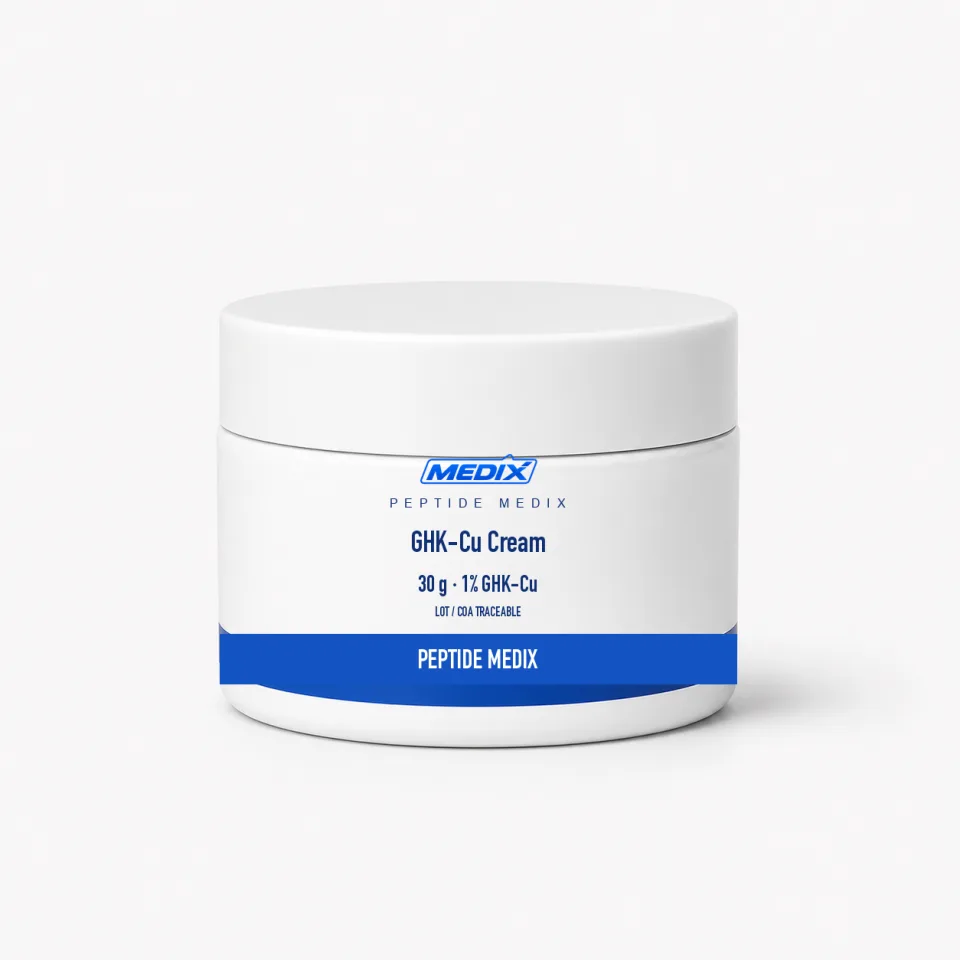
- HPLC-assayed purity of ≥99%
- Certificate of analysis tied to your lot number
- Tracked EU delivery, dispatched the next working day
GHK-Cu Cream
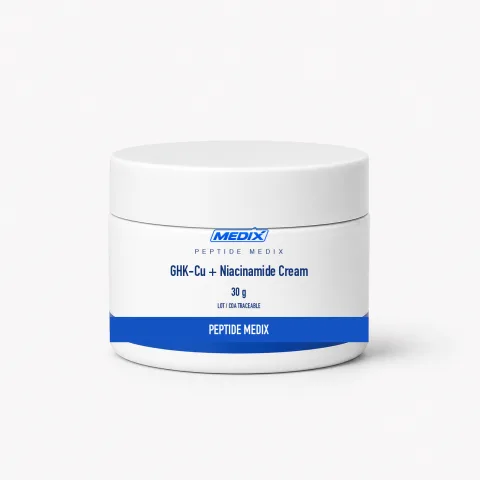
GHK-Cu at 1% in an emollient cream — 30 g and 50 g research jars
In stock2 formats available
€63Range €63 – €85
This listing is currently unavailable. Contact us and we will tell you when it is back or suggest an equivalent.
Ask about this listing or request its COA- FormBlue-tinted emollient cream in a screw-top jar
- Research areasVehicle and occlusion effects, ECM and fibroblast models, copper-peptide stability
For laboratory research use only. Sold exclusively for in-vitro laboratory research by qualified professionals. Not for human or veterinary use, and not a medicine, food, cosmetic or dietary supplement. Terms and Conditions
Overview
Key facts
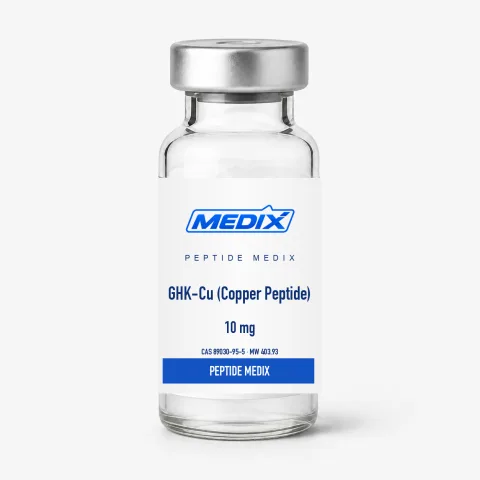
Here GHK-Cu — copper(II) bound to glycyl-L-histidyl-L-lysine — is incorporated at 1% into an emollient cream, about 10 mg of complex per gram.
- CAS number
- 89030-95-5
- Molecular formula
- C14H24N6O4·Cu
- Molecular weight
- 403.93 g/mol
- Form
- Blue-tinted emollient cream in a screw-top jar
- Storage
- Cool and dark, ideally 2–8 °C; keep the jar closed
- Available sizes
- 30 g · 1-pack · 50 g · 1-pack
For research use only. Not for human consumption.
Here GHK-Cu — copper(II) bound to glycyl-L-histidyl-L-lysine — is incorporated at 1% into an emollient cream, about 10 mg of complex per gram. An aqueous serum is designed to deposit its active and then evaporate; a cream, by contrast, leaves a film that occludes the skin. For researchers this matters: occlusion changes how hydrated the stratum corneum is, shifts how a hydrophilic complex partitions and usually lengthens contact time — all of which influence what a permeation or skin-model study actually measures.
GHK-Cu ranks among the best-documented copper peptides. First isolated from human plasma in the 1970s, the tripeptide binds copper strongly and has been investigated in fibroblast cultures, wound models and gene-expression studies for its links to matrix turnover and antioxidant chemistry. Offering it in a cream gives labs a vehicle-matched partner to the aqueous serum for direct vehicle comparisons.
We stock 30 g and 50 g jars, both at 1% GHK-Cu. The peptide input is tested by an independent lab to ≥99% HPLC purity, with a certificate of analysis for the lot. Filled and dispatched from our EU warehouse, for laboratory research only.
What sets this listing apart
GHK-Cu Cream – cream/serum, 30/50 g. Blue-tinted emollient cream in a screw-top jar. Other GHK-Cu listings differ in format, fill or combination partners; the specification and COA always refer to the listing you order.
Same compound, other listings
Specifications
Supply & purity
- Form
- Blue-tinted emollient cream in a screw-top jar
- Available sizes
- 30 g · 1% GHK-Cu; 50 g · 1% GHK-Cu
Additional detail
- Active concentration
- 1% w/w GHK-Cu, approximately 10 mg per gram
- Active
- GHK-Cu, copper(II) complex of glycyl-L-histidyl-L-lysine
- INCI name of active
- Copper Tripeptide-1
- CAS number (active)
- 89030-95-5
- Molecular formula (active)
- C14H24N6O4·Cu
- Molecular weight (active)
- 403.93 g/mol
- Peptide purity input
- ≥99% by HPLC; lot-matched COA available
- Vehicle
- Emollient oil-in-water cream base, no added fragrance
- Research areas
- Vehicle and occlusion effects, ECM and fibroblast models, copper-peptide stability
- Storage
- Cool and dark, ideally 2–8 °C; keep the jar closed
- Compatibility note
- Avoid mixing with strong reducing agents or chelators that disturb copper coordination
Questions about GHK-Cu Cream
How much GHK-Cu is in the cream?
1% w/w in both sizes — about 10 mg of the copper tripeptide complex per gram. The 30 g and 50 g jars differ only in how much they hold, so you can scale a study up without changing formulation.
How is it different from the GHK-Cu serum?
The active is the same but the vehicle differs. The cream is an emollient emulsion that occludes the skin and extends contact, whereas the serum is a light water-based liquid that dries fast. Testing both at the same concentration is a classic way to isolate vehicle effects in skin models.
Is the GHK-Cu in this cream tested, and is there a COA?
Yes. The peptide raw material must meet a ≥99% HPLC purity specification, with identity checked by mass spectrometry, and its lot certificate can be requested. Every jar carries its own lot number, so your lab notes can be traced back to that raw-material certificate.
Why is the cream slightly blue?
The tint comes from the bound copper(II) ion — no dye is added. Intact GHK-Cu is blue, so the colour also serves as a rough integrity check; if it fades or turns greenish, the copper binding has likely been disturbed.
How should jars be stored and sampled?
Keep them closed, cool and dark — refrigerated if possible. Use a fresh, clean spatula each time instead of reusing tools, weigh portions for quantitative work, and record the lot number and date of opening so results can be linked to a specific fill.
Can other actives be added to the cream?
Only after checking compatibility. Strong reducers such as concentrated ascorbic acid, and chelating excipients, compete for the copper and alter which species is actually present. Confirm analytically rather than assuming the complex is still intact.
Related