- HPLC-assayed purity of ≥99%
- Certificate of analysis tied to your lot number
- Tracked EU delivery, dispatched the next working day
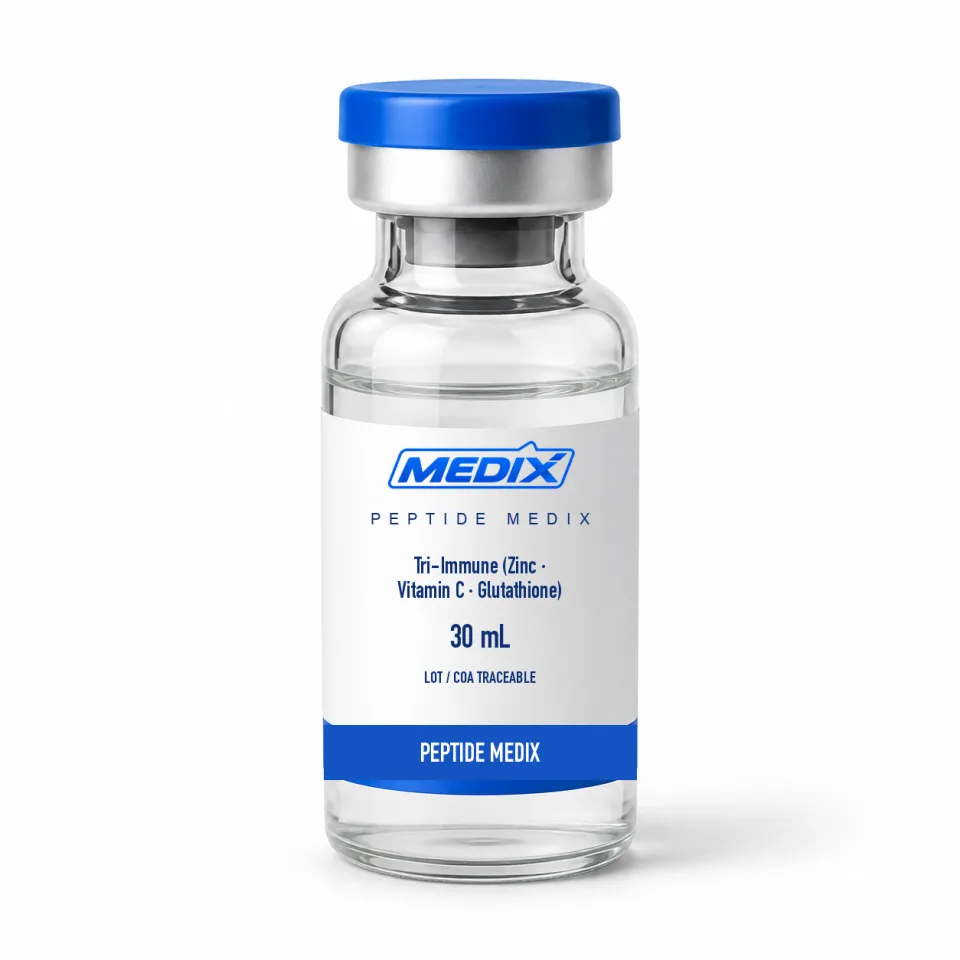
Tri-Immune (Zinc · Vitamin C · Glutathione)
Research solution with three components: zinc, ascorbic acid and reduced glutathione
In stock1 format available
€55
This listing is currently unavailable. Contact us and we will tell you when it is back or suggest an equivalent.
Ask about this listing or request its COA- Research areasMicronutrient cofactor availability, redox buffering, lymphocyte and macrophage assays, metallothionein and zinc-finger studies
For laboratory research use only. Sold exclusively for in-vitro laboratory research by qualified professionals. Not for human or veterinary use, and not a medicine, food, cosmetic or dietary supplement. Terms and Conditions
Overview
Key facts
Hundreds of enzymes, along with the zinc-finger family of transcription factors, need zinc either for their structure or to carry out catalysis, and published models link zinc supply to how much the thymus produces, how fast lymphocytes multiply and how much metallothionein…
- Storage
- 2–8 °C, protected from light; do not freeze
- Available size
- 30 mL
For research use only. Not for human consumption.
Hundreds of enzymes, along with the zinc-finger family of transcription factors, need zinc either for their structure or to carry out catalysis, and published models link zinc supply to how much the thymus produces, how fast lymphocytes multiply and how much metallothionein cells express. Ascorbic acid (CAS 50-81-7, C6H8O6, 176.12 g/mol) is a water-soluble reducing agent that dioxygenases such as the prolyl hydroxylases and TET DNA demethylases depend on as a cofactor. Reduced glutathione (CAS 70-18-8, C10H17N3O6S, 307.32 g/mol) is the cell's main thiol buffer and the substrate that glutathione peroxidases and S-transferases act on.
By design — and as a result — the three interact chemically: ascorbate and glutathione are both reductants within one recycling network, while zinc, a redox-inert transition metal, can have its coordination chemistry shaped by how much thiol is available. The vial label gives each component's concentration, and the lot Certificate of Analysis repeats it.
What sets this listing apart
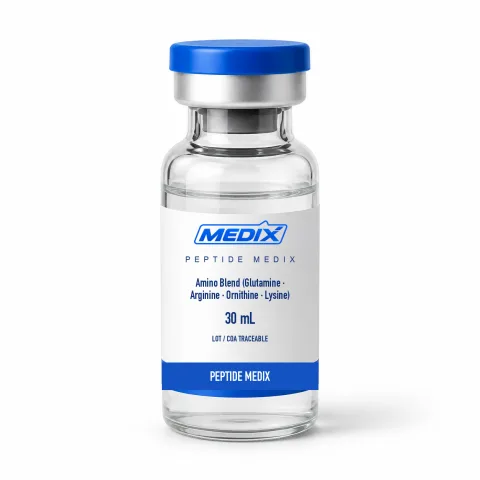
Tri-Immune (Zinc · Vitamin C · Glutathione) – vial, 30 mL. Other L-Glutathione listings differ in format, fill or combination partners; the specification and COA always refer to the listing you order.
Same compound, other listings
Questions about Tri-Immune (Zinc · Vitamin C · Glutathione)
What does the vial hold?
One 30 mL water-based solution containing three ingredients — zinc, ascorbic acid (vitamin C) and reduced L-glutathione. The label shows how concentrated each one is, and the lot's Certificate of Analysis repeats those values, letting you verify your calculations against a documented figure.
Should it be considered a peptide product?
Only one ingredient is. Glutathione is a tripeptide whose first bond is a gamma link; zinc, on the other hand, is a trace mineral and ascorbic acid is vitamin C. That's why we list the solution under vitamins and cofactors and not among the peptide vials.
Can I get a COA?
Yes — a certificate for your batch documents the identity and concentration of each component. Compare the lot number on the vial with the COA before you record any results.
Can I adjust each component separately?
Not with this solution, since its fill sets a fixed ratio. If you want to adjust the amount of zinc, vitamin C or glutathione individually, use our single-ingredient products, and keep this blend for experiments that need the same combined input throughout.
Related