- Every vial assayed to ≥99% (HPLC) with its own lot COA
- Certificate of analysis tied to your lot number
- Tracked EU delivery, dispatched the next working day
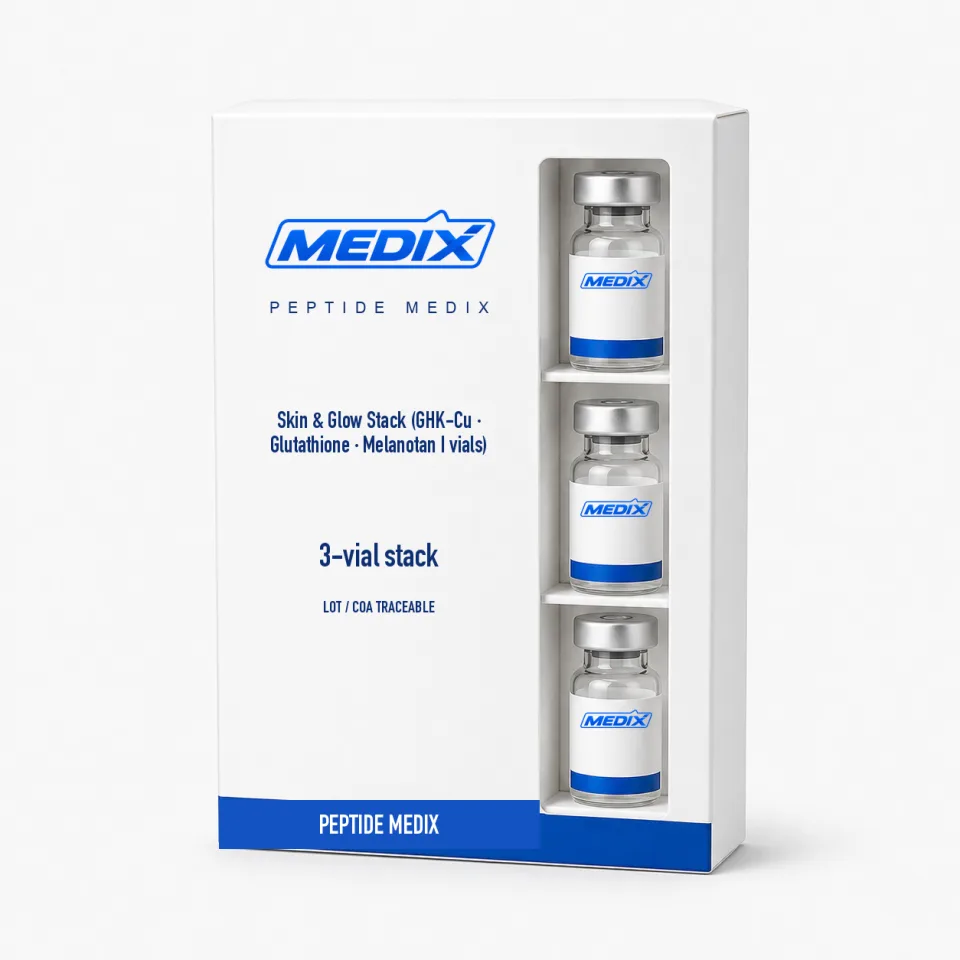
Skin & Glow Stack (GHK-Cu · Glutathione · Melanotan I vials)
Dermatology research kit of three vials: GHK-Cu, L-glutathione and Melanotan I
In stock1 format available
€140
This listing is currently unavailable. Contact us and we will tell you when it is back or suggest an equivalent.
Ask about this listing or request its COA- FormLyophilized powder in each vial, individually capped
- Research areasCollagen and matrix synthesis, redox and thiol biology, MC1R melanogenesis
For laboratory research use only. Sold exclusively for in-vitro laboratory research by qualified professionals. Not for human or veterinary use, and not a medicine, food, cosmetic or dietary supplement. Terms and Conditions
Overview
Key facts
This stack brings together three compounds used in dermatology and pigmentation research, each in its own sealed vial.
- Purity
- ≥99% by HPLC per vial; separate lot-matched COA for each
- Form
- Lyophilized powder in each vial, individually capped
- Storage
- −20 °C, protected from light and moisture
- Available size
- 3-vial stack
For research use only. Not for human consumption.
This stack brings together three compounds used in dermatology and pigmentation research, each in its own sealed vial. They are linked by research context — skin biology — rather than by any common mechanism, and chemically they could hardly differ more.
GHK-Cu is the tripeptide glycyl-L-histidyl-L-lysine with a copper(II) ion attached; it was discovered in human plasma during the 1970s and has since been used in fibroblast cultures to study how cells make collagen and other matrix proteins. L-Glutathione, by contrast, was never designed by anyone — it is the body's own gamma-glutamyl-cysteinyl-glycine, the chief thiol antioxidant found inside almost all cells, and it is researched in redox biology, detoxification and melanin production. Melanotan I (afamelanotide) is an alpha-MSH analogue of 13 amino acids; changes at positions 4 and 7 make it more stable and increase its affinity for MC1R.
Each vial has passed HPLC testing at ≥99% and comes with a certificate for its own lot. Supplying them separately is the right choice because the amounts used differ enormously — glutathione by the hundred milligrams, the two peptides by the ten. For laboratory research use only.
What sets this listing apart
Skin & Glow Stack combines GHK-Cu (Copper Peptide), L-Glutathione and Melanotan I (Afamelanotide) in one listing. Components that are also sold on their own are linked below, each with its own specification and COA.
Same compound, other listings
Specifications
Supply & purity
- Form
- Lyophilized powder in each vial, individually capped
- Purity
- ≥99% by HPLC per vial; separate lot-matched COA for each
Handling & storage
- Storage (lyophilized)
- −20 °C, protected from light and moisture
- Storage (reconstituted)
- 2–8 °C, protected from light; glutathione oxidises readily
Additional detail
- Product type
- Multi-vial research kit — three separately sealed vials
- Kit contents
- One GHK-Cu vial, one L-glutathione vial, one Melanotan I vial
- GHK-Cu
- CAS 89030-95-5 · C14H24N6O4·Cu · 403.93 g/mol
- L-glutathione
- CAS 70-18-8 · C10H17N3O6S · 307.32 g/mol
- Melanotan I (afamelanotide)
- CAS 75921-69-6 · C78H111N21O19 · 1646.87 g/mol
- Melanotan I class
- [Nle4, D-Phe7]-alpha-MSH, 13-residue melanocortin analogue
- Glutathione class
- Endogenous tripeptide gamma-Glu-Cys-Gly; reduced form
- Research areas
- Collagen and matrix synthesis, redox and thiol biology, MC1R melanogenesis
- Reconstitution
- Each vial prepared separately; glutathione is used at far larger mass
Questions about Skin & Glow Stack (GHK-Cu · Glutathione · Melanotan I vials)
Why does the glutathione vial contain so much more?
Because it's used in much larger quantities. A glutathione vial typically contains 600 mg or more, while researchers work with GHK-Cu and Melanotan I in the tens of milligrams — the very reason this kit keeps them in separate vials instead of combining them.
Is there a COA for each vial?
Yes. The vials come from three separate production lots, and each is released with a certificate confirming the identity and HPLC purity of its compound. You'll therefore get three documents, and you can ask for the current versions before ordering.
How do Melanotan I and Melanotan II differ?
Melanotan I (afamelanotide) is an open-chain alpha-MSH analogue of 13 residues that favours MC1R. Melanotan II is shorter — seven residues closed into a ring — and acts on a wider set of melanocortin receptors, MC3R and MC4R included. They are different molecules, used for different research purposes.
Why is GHK-Cu solution blue?
The light blue comes from the copper(II) ion held inside the tripeptide and shows the complex is intact and dissolved. A colourless solution, or one drifting towards green or brown, would be unexpected — set that vial aside.
How stable is glutathione after reconstitution?
It keeps less well than the peptides: exposed to air, reduced glutathione turns into its oxidised disulfide, faster still in light or warmth. Make it up just before use, keep it chilled and in the dark, leave as little air in the vial as possible and avoid storing dilute solutions for extended periods.