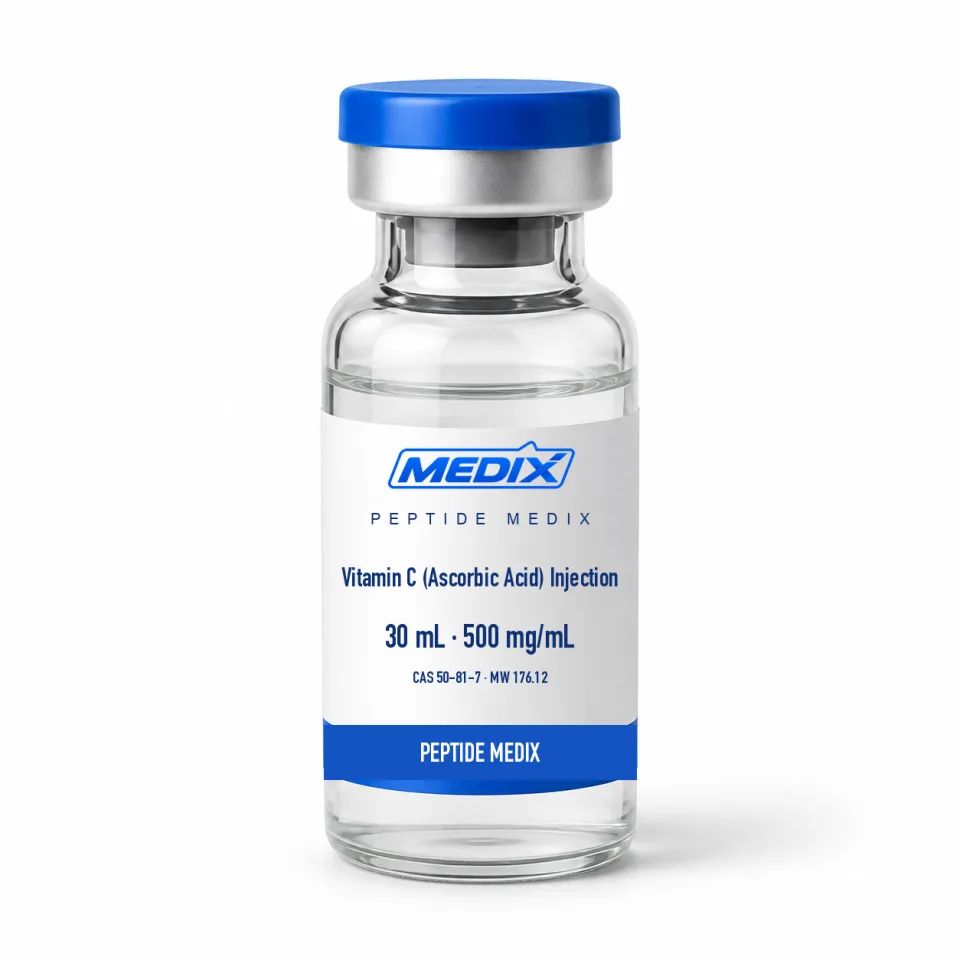
- HPLC-assayed purity of ≥99%
- Certificate of analysis tied to your lot number
- Tracked EU delivery, dispatched the next working day
Vitamin C (Ascorbic Acid) Injection
Ascorbic acid solution at 500 mg/mL in a 30 mL multi-use vial
In stock1 format availableCAS 50-81-7
€46
This listing is currently unavailable. Contact us and we will tell you when it is back or suggest an equivalent.
Ask about this listing or request its COA- FormClear, colourless to pale straw aqueous solution in a sealed glass vial
- Mol. weight176.12 g/mol
- Research areasCollagen maturation, redox buffering in culture, pharmacologic-ascorbate pro-oxidant models, DNA demethylation and stem-cell studies, iron chemistry
For laboratory research use only. Sold exclusively for in-vitro laboratory research by qualified professionals. Not for human or veterinary use, and not a medicine, food, cosmetic or dietary supplement. Terms and Conditions
Overview
Key facts
In the chemistry of the cell, ascorbate plays two roles: it is a reducing agent and a cofactor.
- CAS number
- 50-81-7
- Molecular formula
- C6H8O6
- Molecular weight
- 176.12 g/mol
- Form
- Clear, colourless to pale straw aqueous solution in a sealed glass vial
- Storage
- 2–8 °C, protected from light, tightly stoppered; do not freeze
- Available size
- 30 mL · 500 mg/mL
For research use only. Not for human consumption.
In the chemistry of the cell, ascorbate plays two roles: it is a reducing agent and a cofactor. It hands electrons to a set of enzymes that depend on iron or copper, keeping their metal ions in the reduced state — among them the prolyl and lysyl hydroxylases needed for collagen to mature, dopamine beta-hydroxylase in the making of catecholamines, and the 2-oxoglutarate-dependent dioxygenases such as the TET enzymes and the HIF prolyl hydroxylases. This last group is why ascorbate turns up so often in papers on epigenetics and on how cells sense low oxygen.
Filled at 500 mg per mL, each 30 mL vial contains a total of 15 g of ascorbic acid — far stronger than nutrition research would need, and intentionally so. One key use of concentrated ascorbate is the pharmacological pro-oxidant model: at millimolar levels outside cells, and with transition metals available as catalysts, ascorbate produces hydrogen peroxide rather than acting as an antioxidant — the reverse of what it does at normal body concentrations. Because ascorbic acid is a weak acid, the pH of the solution is adjusted, and much of it is present as the ascorbate ion. Oxidation is the constant enemy: air, light, heat and traces of metal all speed it up, and a clearly darker or cloudy solution is the visible end result.
Specifications
Identity
- CAS number
- 50-81-7
- Molecular formula
- C6H8O6
- Molecular weight
- 176.12 g/mol
Supply & purity
- Form
- Clear, colourless to pale straw aqueous solution in a sealed glass vial
Additional detail
- Concentration
- 500 mg/mL L-ascorbic acid
- Chemical class
- Water-soluble vitamin; six-carbon lactone of a hexonic acid, redox-active
- Chemistry note
- Weak acid; solutions are pH-adjusted, which means part of the content is present as the ascorbate anion
- Enzyme roles
- Prolyl and lysyl hydroxylases, dopamine beta-hydroxylase, 2-oxoglutarate-dependent dioxygenases including TET and HIF-PHD
- Research areas
- Collagen maturation, redox buffering in culture, pharmacologic-ascorbate pro-oxidant models, DNA demethylation and stem-cell studies, iron chemistry
- Oxidation sensitivity
- High — degrades on exposure to air, light, heat and trace transition metals
- Storage
- 2–8 °C, protected from light, tightly stoppered; do not freeze
- Appearance check
- Discard if markedly darkened, cloudy or containing particulates
Questions about Vitamin C (Ascorbic Acid) Injection
What amount of ascorbic acid does the vial hold?
15 g of L-ascorbic acid in total: 30 mL at 500 mg/mL. The certificate for your lot gives the measured assay value together with identity and pH for that batch.
Why does the solution get darker over time?
Ascorbate is oxidised first into dehydroascorbate and then further into diketogulonic acid, and the coloured breakdown products build up. Light, heat, air and small amounts of metals like iron and copper all make this happen faster. If the vial has darkened markedly, gone cloudy or contains particles, discard it instead of testing it.
Do you provide a certificate of analysis?
Yes. Each lot comes with a certificate stating identity, measured concentration, pH and appearance, which we send if you quote the lot number shown on the vial. For a compound that oxidises this easily, having the assay documented is particularly important.
Related