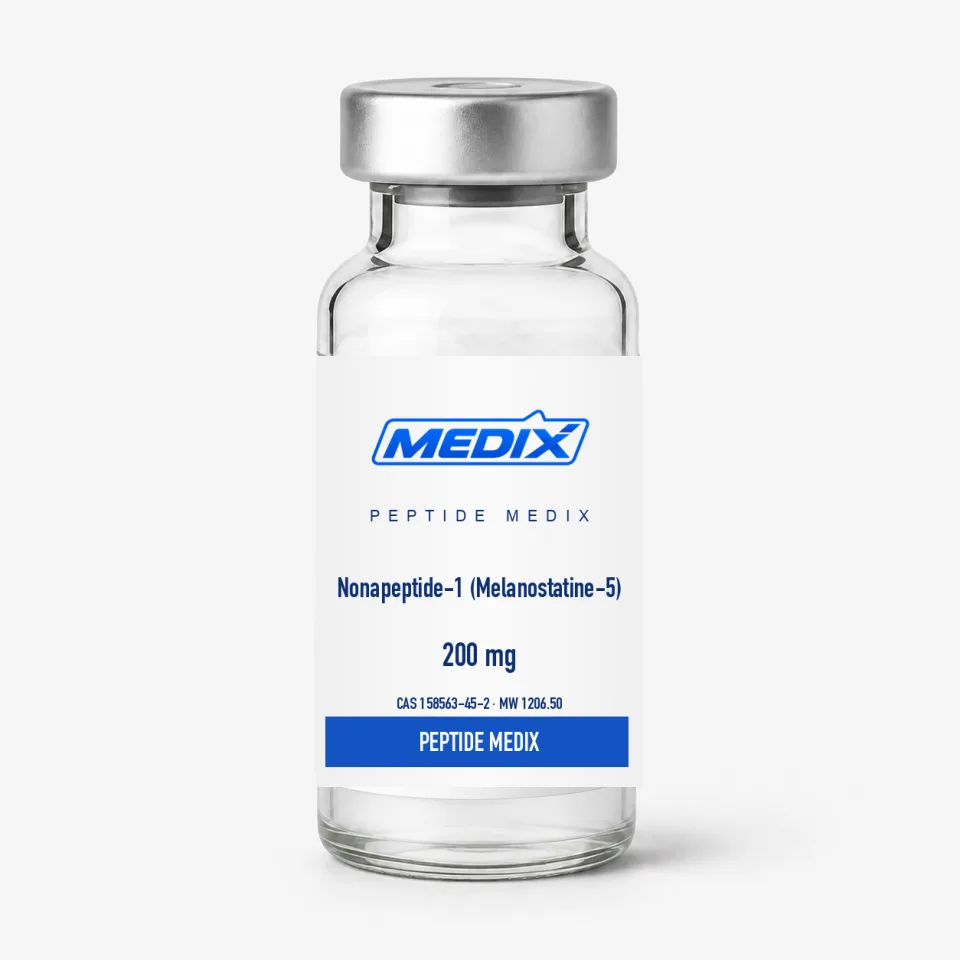
- HPLC purity ≥99%, with a COA for each lot on request
- Certificate of analysis tied to your lot number
- Tracked EU delivery, dispatched the next working day
Nonapeptide-1 (Melanostatine-5)
Amidated nine-residue MC1R-antagonist peptide for melanogenesis research
In stock1 format availableCAS 158563-45-2
€216
This listing is currently unavailable. Contact us and we will tell you when it is back or suggest an equivalent.
Ask about this listing or request its COA- FormLyophilized powder, sealed glass vial
- Mol. weight1206.50 g/mol
- Research areasAlpha-MSH competition, MC1R signaling, tyrosinase regulation and melanogenesis
For laboratory research use only. Sold exclusively for in-vitro laboratory research by qualified professionals. Not for human or veterinary use, and not a medicine, food, cosmetic or dietary supplement. Terms and Conditions
Overview
Key facts
Nonapeptide-1, also called Melanostatine-5, is a synthetic nine-amino-acid peptide with an amidated C-terminus.
- CAS number
- 158563-45-2
- Molecular formula
- C61H87N15O9S
- Molecular weight
- 1206.50 g/mol
- Amino acid sequence
- Met-Pro-D-Phe-Arg-D-Trp-Phe-Lys-Pro-Val-NH2
- Purity
- ≥99% by HPLC; lot-matched COA available
- Form
- Lyophilized powder, sealed glass vial
- Storage
- −20 °C lyophilized; protect powder and solutions from light
- Available size
- 200 mg
For research use only. Not for human consumption.
Nonapeptide-1, also called Melanostatine-5, is a synthetic nine-amino-acid peptide with an amidated C-terminus. Its sequence — Met-Pro-D-Phe-Arg-D-Trp-Phe-Lys-Pro-Val-NH2 — includes two D-amino acids that stabilise its conformation and set it apart from an ordinary all-L peptide. The internal Phe-Arg-Trp stretch recalls part of the His-Phe-Arg-Trp message sequence shared by melanocortin ligands, although this analogue lacks that motif's histidine. It emerged from melanocortin peptide-library screening as a candidate antagonist of the melanocortin-1 receptor (MC1R).
We stock it only as a 200 mg vial — a large fill for a peptide in this price range — because of the work it is bought for: melanogenesis models and topical formulation studies use up material faster than milligram vials could supply. Assays are designed competitively, profiling the peptide against alpha-MSH at MC1R with readouts such as cAMP accumulation, tyrosinase activity and melanin content in melanocyte or melanoma cultures. Melanotan I, the 13-residue alpha-MSH analogue listed elsewhere in our catalogue, sits at the agonist end of the same receptor pharmacology and is the natural comparator. Keep the lyophilised powder at −20 °C and protect both powder and solutions from light.
Specifications
Identity
- CAS number
- 158563-45-2
- Molecular formula
- C61H87N15O9S
- Molecular weight
- 1206.50 g/mol
- Amino acid sequence
- Met-Pro-D-Phe-Arg-D-Trp-Phe-Lys-Pro-Val-NH2
- Chain length
- 9 residues, C-terminally amidated
Supply & purity
- Form
- Lyophilized powder, sealed glass vial
- Purity
- ≥99% by HPLC; lot-matched COA available
Additional detail
- Available size
- 200 mg
- Also known as
- Melanostatine-5, Melanostatine 5, Nonapeptide-1
- Research target
- Melanocortin-1 receptor (MC1R) antagonist models
- Research areas
- Alpha-MSH competition, MC1R signaling, tyrosinase regulation and melanogenesis
- Storage
- −20 °C lyophilized; protect powder and solutions from light
Questions about Nonapeptide-1 (Melanostatine-5)
What is Nonapeptide-1?
A synthetic nine-amino-acid peptide, also known as Melanostatine-5, developed as a candidate MC1R antagonist. Its sequence contains D-phenylalanine and D-tryptophan and finishes with a C-terminal amide.
How does it compare with Decapeptide-12?
Nonapeptide-1 is mainly investigated at the receptor level, competing with alpha-MSH at MC1R. Decapeptide-12 is studied more directly as an inhibitor of tyrosinase. They act on different stages of melanogenesis and complement each other as comparison reagents rather than duplicating one another.
Why do the D-amino acids matter?
D-Phe3 and D-Trp5 change the peptide's 3D shape and its sensitivity to proteases. A version built with the matching L-residues would be a different research compound, even though the residue names on a label might look the same.
What purity paperwork is available?
Every lot is analysed by reversed-phase HPLC to ≥99% purity, and its certificate of analysis can be requested. Mass confirmation should correspond to the amidated form of the peptide.
How do I store Nonapeptide-1?
Keep the sealed powder at −20 °C, away from moisture and light. Refrigerate solutions for a defined study period, and use aliquots if the work runs over several sessions.
Related